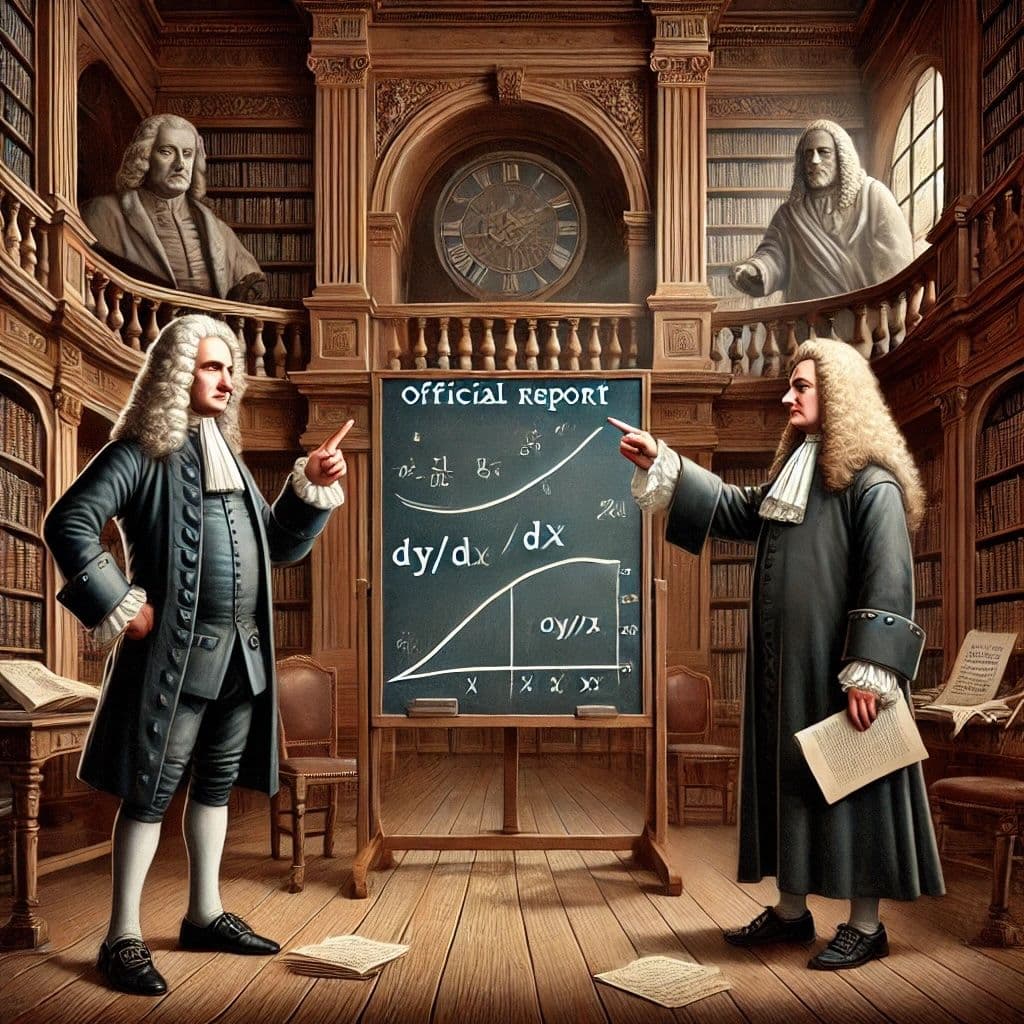
Here’s a question for you: what happens when two of the greatest intellects in human history decide they hate each other’s guts?
The answer isn’t pretty. It’s a story of towering ego, breathtaking pettiness, and a smear campaign that would make a modern politician blush. It’s the story of the invention of calculus, and the bitter, decades-long feud between Isaac Newton and Gottfried Wilhelm Leibniz.
We often imagine the pioneers of mathematics as serene, white-haired sages, floating above the grubby concerns of mortal men, their minds occupied only by the pure, eternal truths of the universe. The story of Newton vs. Leibniz is the perfect antidote to that fantasy. It reminds us that even those who peer into the very fabric of reality are still human, subject to envy, pride, and a desperate, clawing need for credit.
This wasn't just a scholarly disagreement. This was the original, and perhaps greatest, nerd war of all time. So, grab a cup of tea, settle in, and let's dive into the drama.
The Protagonists: A Study in Contrasts
To understand the feud, we first need to meet our combatants. They could not have been more different in temperament, background, and lifestyle.
Isaac Newton: The Reclusive, Volatile Genius of England
If you were casting a movie about a tortured, obsessive genius, Isaac Newton would be your man. Born prematurely in Woolsthorpe, England, in 1642 (the year Galileo died), Newton had a lonely and difficult childhood. He was a solitary figure, brilliant but socially awkward, prone to towering rages and deep, brooding silences.
His intellectual capacity was staggering. During the "Annus Mirabilis" (Year of Wonders) of 1666, while secluded at his family home to escape the plague rampaging through Cambridge, he laid the foundations for calculus, theorized on the nature of light and color, and began his work on the law of universal gravitation. He did all of this, essentially, in his spare time, for his own satisfaction.
Newton was secretive and paranoid. He often worked in ciphers and was notoriously reluctant to publish. For him, knowledge was a personal possession to be revealed only when it was perfectly polished, and he was ready to face the inevitable criticisms. He saw the world in absolutes and had a lifelong, almost pathological inability to share credit.
Gottfried Wilhelm Leibniz: The Cosmopolitan, Courtly Polymath of the Continent
Leibniz, born in Leipzig in 1646, was Newton's polar opposite. Where Newton was a recluse, Leibniz was a man of the world. A diplomat, lawyer, historian, and librarian, he was a brilliant networker who moved effortlessly through the royal courts of Europe.
His mind was encyclopedic, buzzing with ideas across a dizzying array of fields. He dreamed of systematizing all human knowledge, created one of the first practical mechanical calculators, and developed a sophisticated philosophical system. Leibniz was an optimist, a communicator, and a collaborator. He believed in the free exchange of ideas to advance human understanding.
This fundamental difference in character-Newton, the secretive, paranoid geniu,s versus Leibniz, the open, sociable polymath-set the stage for an inevitable collision.
The Setup: A Tale of Two Discoveries
Here’s the crucial, and often misunderstood, fact: both Newton and Leibniz independently developed the core ideas of calculus.
They started from different places and used different notations, but they both arrived at the same monumental insight: a systematic way to deal with the twin problems of finding the slope of a curve at any point (differentiation) and the area under a curve (integration), and understanding the profound inverse relationship between the two.
Newton’s "Method of Fluxions" (c. 1666)
Newton called his calculus the "method of fluxions." He thought of curves as being generated by the continuous motion of a point. He considered variables as "fluents" (flowing quantities) and their rates of change as "fluxions" (represented by a dot over the variable, like ). He developed his fundamental theories in the 1660s, and by 1669, he had written up his ideas in a manuscript, De Analysi per Aequationes Numero Terminorum Infinitas ("On Analysis by Equations with an Infinite Number of Terms"). He circulated this privately among a small circle of colleagues in London but, characteristically, did not formally publish it.
Leibniz’s "Differential Calculus" (c. 1675)
Leibniz arrived at his version of calculus a few years later, in the mid-1670s. His approach was more algebraic and geometrical. His great and enduring contribution was his notation. He introduced the and for differentials and the elegant elongated for the integral. This notation was, and still is, intuitively brilliant. It clearly suggested the processes involved and was far more flexible and usable than Newton's dot-notation for the complex calculus that would follow.
Leibniz began publishing his work in a series of papers starting in 1684, in the Acta Eruditorum, a leading German scientific journal. His system was clear, his notation was superior, and it was public.
So, the timeline is clear:
- Newton invented it first (c. 1666).
- Leibniz published it first (c. 1684).
For a while, a tense peace prevailed. There were whispers and rumors of plagiarism, but a direct confrontation was avoided. An early draft of a letter from Newton to Leibniz even acknowledged their independent work. But the peace was fragile, built on a foundation of mutual, simmering suspicion.
The Drama Erupts: The Cannonball of Conflict
The first major public shot in the war was fired not by Newton or Leibniz, but by a Swiss mathematician named Nicolas Fatio de Duillier. Fatio was a young, fervent admirer of Newton-some historians suggest he may have been in love with him-and he developed a fierce loyalty to the Englishman.
In 1699, Fatio published a paper in which he essentially accused Leibniz of plagiarizing Newton. He didn't mince words, implying that Leibniz had seen Newton's unpublished manuscripts and then dressed up the ideas in his own notation. This was a serious, career-ending accusation.
Leibniz, the consummate diplomat, was stung. He responded not with a direct assault on Newton, but by lodging a formal complaint with the Royal Society of London, of which he was a member. He demanded an apology and a retraction.
This was a catastrophic miscalculation.
The Punchline: Newton’s Masterclass in Petty
By the time Leibniz lodged his complaint in 1711, Isaac Newton was no longer just a reclusive Cambridge professor. He was a powerful, well-connected national figure. He had been Warden, and then Master, of the Royal Mint-a position he took with terrifying seriousness, personally pursuing and prosecuting counterfeiters with a vengeful fury. More importantly, he had been President of the Royal Society since 1703.
Leibniz had, in effect, asked the boss to investigate himself.
Newton saw his chance. He assembled a committee to investigate the "dispute" and provide a definitive answer. This was no impartial jury of peers. Newton packed it with his friends, allies, and sycophants. The committee’s report, published in 1712, was a foregone conclusion. It was titled Commercium Epistolicum ("The Exchange of Letters") and it meticulously "proved" that Newton was the first inventor and, by heavy implication, that Leibniz was a derivative second-comer.
But Newton’s pettiness didn't stop there. This is where the story transcends mere academic rivalry and enters the realm of pure, unadulterated absurdity.
1. The Ghostwriter-in-Chief: Newton didn't just influence the committee; he was the committee. He secretly wrote the final report himself. Imagine the scene: the President of the Royal Society, hunched over a desk, furiously penning the official document that would exonerate himself and condemn his rival.
2. The Self-Review: If writing the report that praised yourself wasn't enough, Newton then took it a step further. He anonymously wrote a lengthy, glowing review of his own report for the Royal Society's own publication, Philosophical Transactions. In this review, he praised the "impartial" and "meticulous" work of the committee (i.e., himself) and further trashed Leibniz's claims. It was a breathtaking act of self-promotion and propaganda.
3. The Lifelong Smear Campaign: For the rest of his life, Newton used his immense power and influence to systematically destroy Leibniz's reputation across Europe. He ensured that any new edition of the Commercium Epistolicum was widely distributed. He manipulated appointments and publications to sideline anyone who supported Leibniz. He turned the entire English mathematical establishment against the German, creating a schism between "British calculus" and "Continental calculus" that would last for a century.
Leibniz, for his part, fought back with a series of pamphlets and letters, but he was outgunned. He was a diplomat fighting a war, while Newton was a warlord who happened to do mathematics. The conflict consumed Leibniz's final years. When he died in 1716, he was a largely isolated and embittered man, his funeral attended by only one mourner-his secretary.
Newton, on the other hand, lived to see himself enshrined as a national hero. He died in 1727 and was buried with immense pomp in Westminster Abbey, a testament to his towering status. It is said that Voltaire, observing the spectacle, remarked, "Newton was a great man... in mathematics, at least, it was sure that he had no rivals. The whole of the war between him and Leibniz on the invention of fluxions... was a great disgrace to England."
The Aftermath: A Century of Stagnation and a Lasting Legacy
The fallout from this feud was more than just personal tragedy; it was a setback for the entire field of mathematics.
Because of Newton's dominance in England, British mathematicians stubbornly clung to his clunky dot-notation for fluxions. On the Continent, mathematicians adopted and refined Leibniz's far superior dy/dx and integral notation. The result was a century where British mathematics stagnated, isolated from the rapid advances being made in Europe by the Bernoulli brothers, Euler, and others. It wasn't until the 19th century that Britain finally abandoned Newton's notation and rejoined the mathematical mainstream, having lost a hundred years of progress to nationalistic pride.
Today, history's judgment is clear and fair. We use the name "calculus" (Leibniz's term, not Newton's "fluxions") and we almost exclusively use Leibniz's notation because it is simply better. The dy/dx notation makes the chain rule and other advanced concepts intuitively clear in a way Newton's dots never could. The integral sign, ∫, is a work of art.
But we also acknowledge that the underlying theory was developed independently by both men. The standard modern verdict is "Newton first, Leibniz first to publish." It is a shared glory, however unwillingly that share was given.
The Human Lesson in the Mathematical Drama
So, what do we take away from this spectacular, 300-year-old train wreck?
The Myth of the Lone Genius: The story dismantles the romantic idea of the solitary genius who single-handedly changes the world from his ivory tower. Calculus was an idea whose time had come. It was built on the work of predecessors like Fermat, Descartes, and Barrow. That two men, working independently, could arrive at the same monumental conclusion suggests that the discovery was, in a sense, inevitable. The world was ready for calculus; it just needed the right minds to piece it together.
The Power of Notation: Leibniz won the long game not because his ideas were better, but because his language was. His notation was a superior tool for thought and communication. This is a vital lesson in mathematics and science: a brilliant idea is only as powerful as your ability to express it and for others to build upon it.
The Poison of Priority: The feud is a timeless cautionary tale about the corrosive nature of the "priority dispute." The desperate need to be first, to be the only one, can poison collaboration, stifle progress, and destroy lives. Newton's genius was undeniable, but his legacy is forever stained by the vindictive lengths he went to in order to secure his priority. He could have been the co-discoverer; he chose instead to be the destroyer.
The story of Newton and Leibniz is more than a funny historical anecdote. It is a profound human drama played out on the highest intellectual stage. It reminds us that the pursuit of truth is often tangled up with the basest of human emotions. The same mind that can unlock the secrets of the cosmos can also be consumed by a petty jealousy that seems, to us, laughably small.
It’s a story that makes the giants of history human again, and in doing so, perhaps makes our own intellectual struggles and occasional pettiness feel a little more understandable. After all, if the man who discovered the laws of motion and universal gravitation could get caught up in something so trivial, what hope do the rest of us have?
But let’s strive to be a little more like Leibniz in our collaborations and a little less like Newton in our rivalries. The progress of knowledge depends on it.