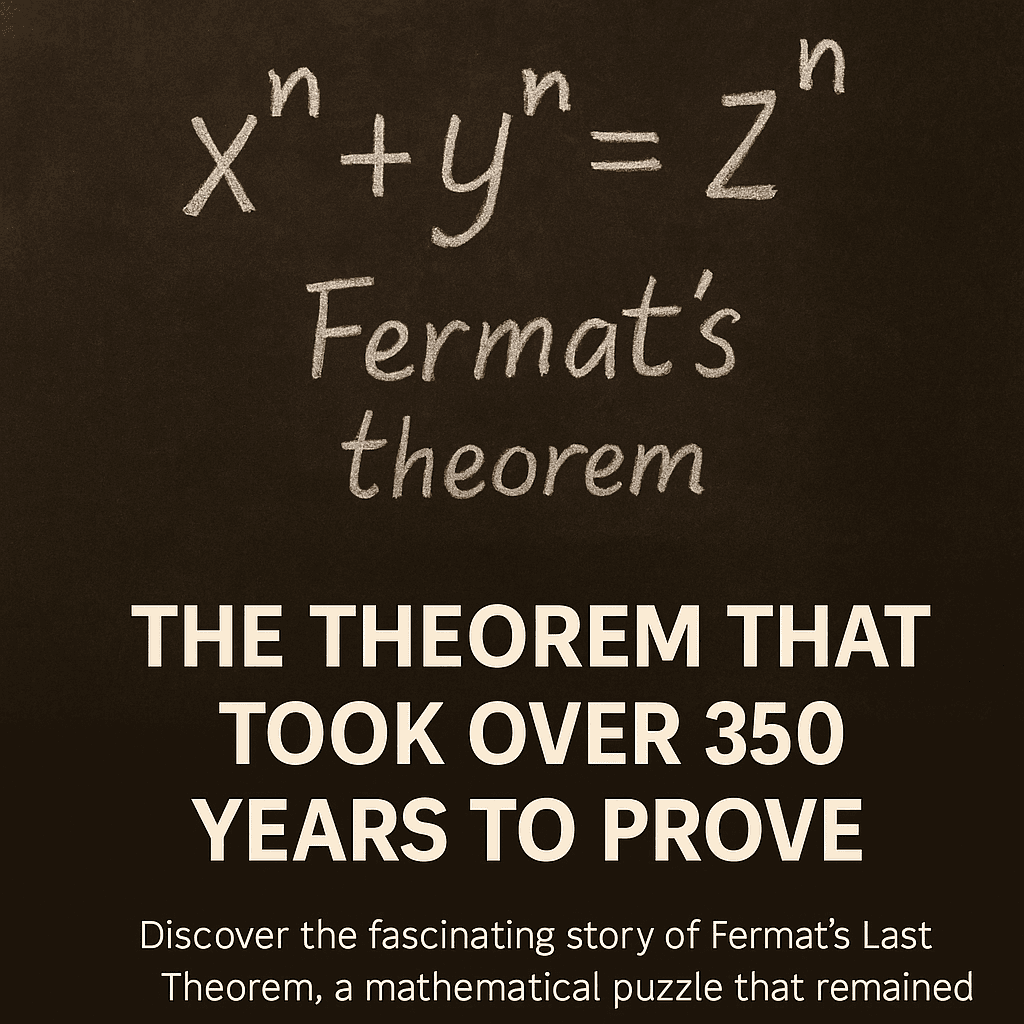
Imagine stumbling upon a scribbled note in an old book, one that quietly claims to solve a riddle that had tormented the finest minds for centuries. No explanation, no details. Just a sentence in the margin. This is the story of how one such note changed the course of mathematical history.
In 1637, the French lawyer and amateur mathematician Pierre de Fermat jotted down a note in the margin of his copy of an ancient Greek text, Arithmetica by Diophantus. The note read, roughly translated: "I have discovered a truly marvelous proof of this proposition that this margin is too narrow to contain." That one cryptic sentence would go on to haunt mathematicians for over 350 years.
The proposition in question was deceptively simple. It was a generalization of the Pythagorean theorem, familiar to anyone who studied triangles in school. Fermat claimed that there are no three positive whole numbers that satisfy a particular type of equation involving powers greater than two. His son later published the marginal note after Fermat’s death, and so began the legend of what would become known as Fermat’s Last Theorem.
For centuries, this little theorem stood as a challenge. One by one, proofs for specific cases emerged. Mathematicians were able to show the theorem held for many powers, but not all. The beauty of mathematics is that one counterexample is enough to disprove a general claim, yet proving that no counterexamples exist is often a Herculean task.
The mystery of Fermat's proof was tantalizing. Did he really have a complete proof? If so, where was it? Why did he never share it? Historians and mathematicians debated this endlessly. Many believed that Fermat had a flawed or incomplete idea—brilliant, perhaps, but not rigorous by modern standards. And as the field of mathematics evolved, it became increasingly clear that any valid proof would require tools and ideas that had not yet been discovered in Fermat's time.
This leads us to the 20th century, and a man named Andrew Wiles.
From the time he was a boy growing up in England, Andrew Wiles was fascinated by Fermat’s Last Theorem. At the age of ten, he found the problem in a library book and was instantly captivated. As he would later describe, it was a puzzle that he couldn't forget, an itch in the brain he felt destined to scratch.
Wiles became a mathematician, but his academic path veered away from Fermat for many years. The theorem was considered too difficult and too disconnected from modern mathematics to be a fruitful area of study. But in the 1980s, a breakthrough occurred. Mathematicians discovered a surprising link between Fermat’s Last Theorem and a completely different field: the theory of modular forms and elliptic curves.
At the heart of this connection was the Taniyama-Shimura conjecture, a deep and technical statement in number theory. In layperson's terms, it proposed a bridge between two areas of mathematics that had previously seemed unrelated. What made this connection explosive was a proof by Gerhard Frey, who showed that if Fermat’s Last Theorem were false, it would violate the Taniyama-Shimura conjecture. Therefore, if the conjecture could be proven true for a wide class of cases, Fermat’s Last Theorem would also be proven.
This was Wiles’s moment. In 1986, he decided to return to the theorem that had inspired his childhood curiosity. But he did it in secret. For seven years, Wiles worked in solitude, driven by the fear that someone else might solve the problem first or that the mathematics would lead him into a dead end.
In 1993, he announced his proof in a series of lectures at Cambridge University. The room was packed. The audience was rapt. For three days, he revealed his work, culminating in the declaration that he had proven Fermat’s Last Theorem. The mathematical world was in awe.
But then came the twist.
A flaw was found. A subtle error in one part of the argument threatened to unravel the entire proof. Wiles was devastated. But instead of collapsing, he redoubled his efforts. With the help of his former student Richard Taylor, he found a new approach. In 1994, a revised proof was published. It was accepted as correct. More than three centuries after Fermat's note, the theorem was finally proven.
The emotional impact was profound. People who had never thought about math were moved by the story of human perseverance and intellectual adventure. Wiles was awarded numerous honors, including a special recognition by the International Mathematical Union. But the greatest reward, as he described it, was the moment he knew the proof was complete.
So what can we learn from this tale?
First, mathematics is a human endeavor. It may appear cold and abstract, but it is driven by curiosity, passion, and tenacity. Fermat's Last Theorem stood not just as a mathematical challenge but as a symbol of the enduring human desire to understand.
Second, the story reminds us that progress often comes from unexpected connections. The path to solving Fermat’s puzzle lay not in following Fermat's footsteps, but in building entirely new structures of thought. Elliptic curves, modular forms, and decades of collaborative insights all fed into a resolution that was larger than any one person.
Lastly, the saga of the theorem shows that even small things—like a scribbled note in a margin—can change the course of history. Ideas have a life of their own. Once released into the world, they inspire, challenge, and occasionally outlast their creators.
The proof of Fermat’s Last Theorem is a monument not just to the brilliance of Andrew Wiles, but to the centuries of mathematicians who chipped away at its mystery, who believed that a solution was out there, waiting to be found.
And perhaps that is the most powerful message of all: in mathematics, as in life, the journey matters just as much as the destination. Every step along the way, every false start, every near miss, every late-night epiphany—they are all part of the beautiful, invisible architecture of discovery.
So next time you glance at a page and see a scribbled note in the margin, remember: it might just contain the seed of the next great idea.
Thanks for reading! If you enjoyed this story, share it with a friend and explore more fascinating tales from the world of mathematics right here on the blog.