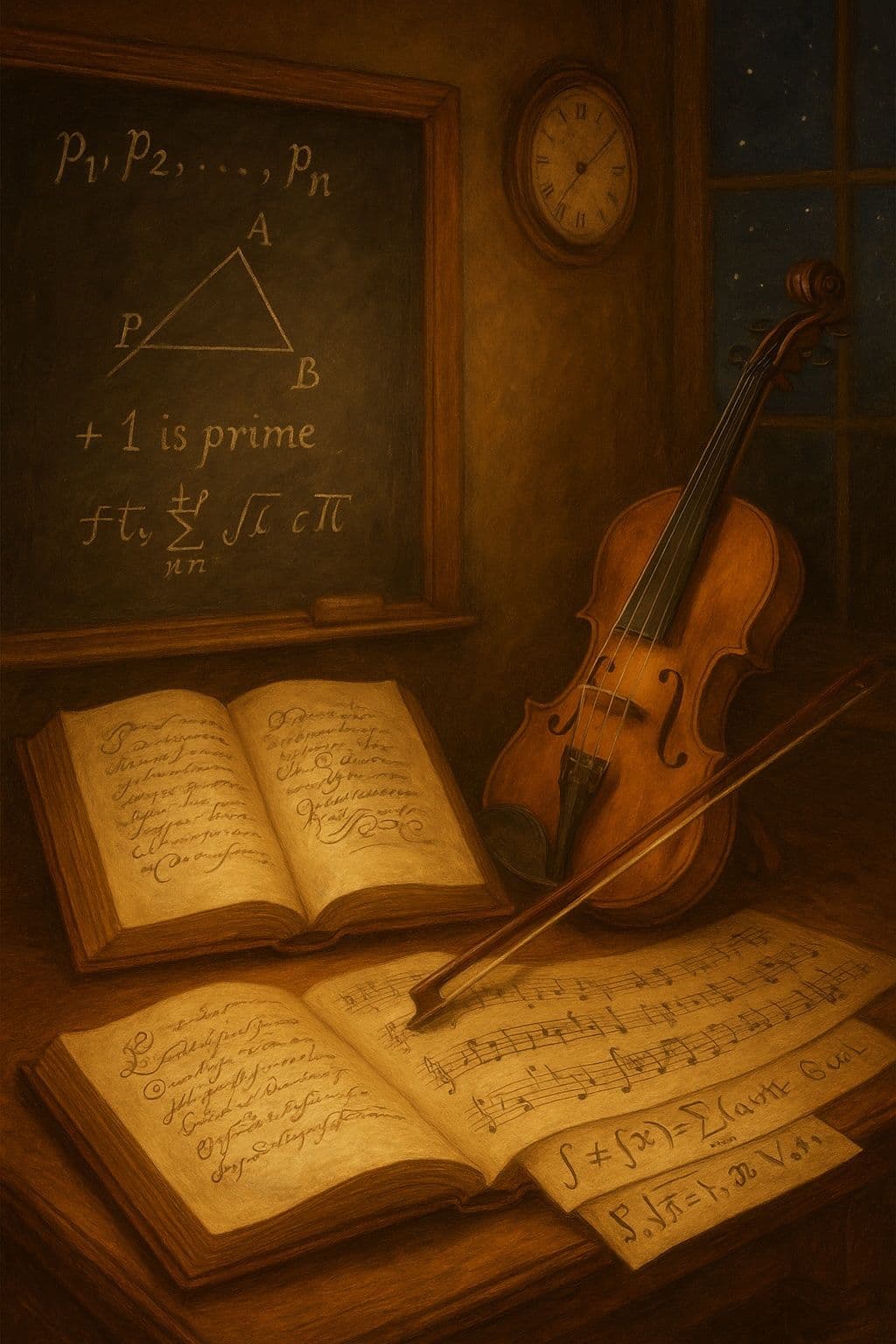
There is a moment in mathematics when the chaos clears-when all the scribbles, crossed-out guesses, and half-formed intuitions align and collapse into a single, crystalline insight. It is a moment not unlike the swell of a symphony resolving into harmony or a line of poetry snapping shut like a well-crafted box. In that moment, we are not just solving a problem. We are witnessing something eternal, as if pulling back the curtain on the architecture of the cosmos.
Mathematical proofs, music, and poetry-on the surface, these might seem like disjoint worlds. The first, a domain of cold, hard logic; the others, playgrounds for emotion, rhythm, and metaphor. Yet anyone who has lived long enough in the orbit of all three knows that their cores are forged of the same substance: elegance, structure, resonance, and timelessness. They are different languages, yes, but all speak of the same longing-the human desire to make sense of the world and our place in it.
Proof as Poetry
Take, for example, the proof of the infinitude of prime numbers. This proof, attributed to Euclid, is over two thousand years old. And yet, it remains as lucid and powerful as the day it was first written. It goes something like this: Suppose the list of prime numbers is finite. Multiply all of them together and add one. The result, call it N, is either prime itself or divisible by a prime not on the list. In either case, we have a contradiction. Therefore, the list must be infinite.
In just a few lines, we are led through an argument that is both simple and profound. The logic is tight, the conclusion inevitable, and the surprise-the unexpected turn-worthy of any great poem. Much like a Shakespearean sonnet, it unfolds in a carefully measured rhythm, builds toward a volta, and ends in revelation.
Poetry does not explain; it reveals. It turns inward and outward at once, holding a mirror to the soul and to the world. A good mathematical proof does the same. It does not merely verify a result; it illuminates it, making us see the invisible scaffolding that holds the universe in place.
Mathematics as Music for the Mind
And what of music? How can a sequence of tones, without words or arguments, stir the same awe as a theorem? Because music, too, is a kind of proof-one that works not by formal logic but by a logic of feeling. A symphony by Bach is a masterclass in structure and recursion. Themes are introduced, transformed, developed, and resolved with a precision that mirrors the steps of a rigorous mathematical derivation.
Consider Bach’s The Art of Fugue, a work of such intricacy and balance that it feels more discovered than composed. It takes a single musical subject and builds an entire cathedral of sound around it, echoing it in inversion, augmentation, diminution. Like a proof by induction, it proceeds with discipline and grace. It teaches the ear what to expect, then challenges and fulfills those expectations with perfect inevitability.
Mathematics and music both rely on pattern, tension, and resolution. They reward deep attention. They are compact expressions of enormous complexity. And above all, they carry within them a beauty that is not arbitrary, but necessary-what the philosopher Roger Scruton called “the soul in search of order.”
The Aesthetic of Elegance
Elegance is perhaps the most elusive yet vital quality in all three domains. Mathematicians speak of elegant proofs with the same reverence that poets reserve for lines that sing and musicians for phrases that soar. Elegance is not just brevity-it is inevitability. It is the sense that no part could be removed, no step re-ordered, without marring the whole.
This is why Paul Erdős spoke of a hypothetical “Book” in which God keeps the most beautiful proofs. When a mathematician discovers a particularly stunning result, Erdős would say, “That’s one for the Book.” Such proofs do not merely work-they belong. They have a rightness that feels almost moral.
So too with a perfect haiku or a sonata. There is nothing extraneous, nothing wasted. And while the tools differ-logic in math, metaphor in poetry, harmony in music-the craftsmanship is the same: to shape complexity into clarity, to make the infinite sing in the finite.
Emotion and Insight
One might object: where is the emotion in a proof? How can a chain of deductions stir the heart? But the seasoned mathematician knows: the moment of proof is one of the most emotional experiences available to the intellect.
It is the thrill of connection, the joy of recognition, the shock of beauty when chaos reveals itself as order. This is the same alchemy that makes us weep at a final stanza or feel chills at the crescendo of a string quartet. The medium is different, but the impact is the same: a sudden expansion of the soul.
The writer G.H. Hardy, in A Mathematician’s Apology, wrote that the best mathematics is serious as well as beautiful-“like the best literature, it must be permanent.” He believed that mathematics was a creative art, not a mechanical craft. And indeed, the same creative fire that drove Keats or Mozart burned in Euler and Gauss. Each sought to speak the unspeakable in the language they knew best.
Timelessness and Universality
Another quality that unites proofs, poems, and preludes is their defiance of time. A proof by Euclid, a verse by Rilke, a fugue by Bach-they remain as potent now as the day they were born. They are not dated by fashion or diminished by repetition. They do not lose their power when translated or transposed. Why? Because they speak not to the surface, but to the essence.
A mathematical truth is true in every universe, in every age. The same could be said, in a different register, of a profound poem or a transcendent symphony. They tap into patterns that feel older than the world.
This is why a child encountering Pythagoras’s theorem for the first time feels a thrill not unlike a child hearing the opening of Beethoven’s Fifth. It is a recognition not just of sound or shape, but of meaning. Something is being said that cannot be unsaid. It is, in a word, universal.
Creativity as Constraint
Paradoxically, all three domains achieve their freedom through constraint. The poet has meter and rhyme; the composer has key and tempo; the mathematician has axioms and definitions. These are not cages-they are launchpads.
Constraints force creativity. They sharpen thought. They give form to intuition. Just as a strict poetic form like a sonnet can produce extraordinary invention, so too can a rigorous mathematical framework give rise to ideas that seem almost magical in their depth and reach.
This interplay between freedom and form is central to the beauty of all three disciplines. They are not chaotic. They are not purely expressive. They are disciplined acts of discovery, where creativity dances with necessity.
Conclusion: The Echo of Infinity
What, then, do we make of this convergence? That the mathematician, the musician, and the poet are all artisans of order. That they seek, each in their own way, to reveal a hidden structure beneath the surface of things. That the joy of proof is not so different from the joy of verse or the joy of harmony.
In a world often fractured by noise and distraction, these three remind us of the possibility of coherence. They whisper to us of eternity. They prove-not in words, but in form-that beauty is not a luxury, but a necessity of the spirit.
As the poet Edna St. Vincent Millay once wrote:
“Euclid alone has looked on Beauty bare.”
But so too have Bach and Rilke. And perhaps, in those quiet moments when we read a line, hear a chord, or trace the steps of a proof, we do too.