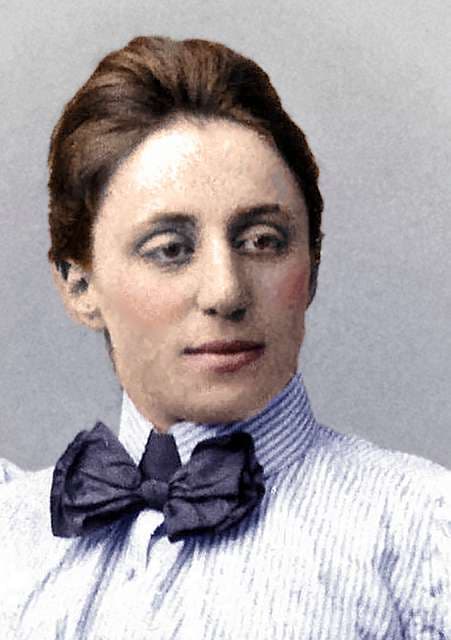
Emmy Noether, born Amalie Emmy Noether on March 23, 1882, in Erlangen, Germany, stands as one of the most influential mathematicians of the 20th century, earning the revered title of the "Mother of Modern Algebra." Her groundbreaking contributions to abstract algebra and theoretical physics, achieved against a backdrop of personal and societal challenges, have left an indelible mark on mathematics and science. A woman of extraordinary intellect and resilience, Noether’s work reshaped the foundations of her field and continues to inspire researchers, students, and innovators worldwide. Her life story is not just a tale of mathematical brilliance but also a testament to the power of perseverance in the face of adversity.
A Challenging Path to Education: Breaking Barriers
Noether’s journey into the world of mathematics was far from conventional. Growing up in a scholarly family-her father, Max Noether, was a respected mathematician-she was initially steered toward more “traditional” pursuits for women of her time. As a young woman, she studied languages, earning a teaching certificate in English and French by 1900, which allowed her to teach briefly. However, her true passion lay in the elegance of numbers and equations. Inspired by her father’s work, she sought to follow in his footsteps, a decision that required overcoming significant hurdles.
In 1903, Noether began auditing mathematics classes at the University of Erlangen, as women were not yet permitted to enroll as regular students. This restriction reflected the gender biases of the era, but Noether’s determination shone through. She attended lectures with permission, absorbing complex concepts in algebra and analysis. Her persistence paid off in 1907 when the university finally allowed women to matriculate, enabling her to pursue a doctorate. Under the guidance of Paul Gordan, a leading expert in invariant theory, she completed her dissertation on the invariants of ternary biquadratic forms, earning her degree with distinction at age 25. This milestone marked the beginning of a career that would challenge the status quo and redefine mathematics.
Revolutionizing Abstract Algebra: A New Mathematical Language
Noether’s most transformative legacy lies in her development of abstract algebra, a field that shifted mathematics from concrete problem-solving to the study of abstract structures. In the 1920s, while working at the University of Göttingen, she introduced groundbreaking concepts that became the bedrock of modern algebra. Her work on rings, fields, and ideals provided a unified framework, allowing mathematicians to generalize and explore algebraic systems with unprecedented depth. The introduction of Noetherian rings-algebraic structures where every ascending chain of ideals stabilizes-revolutionized commutative algebra and algebraic geometry. These rings, named in her honor, are now indispensable tools in understanding complex mathematical systems.
Her approach was revolutionary because it emphasized abstraction over specific examples. For instance, she showed how properties of polynomial rings could be extended to broader contexts, influencing areas like number theory and topology. Her seminars at Göttingen attracted brilliant minds, including future luminaries like B.L. van der Waerden, who credited her with shaping his seminal textbook Modern Algebra. This work didn’t just advance academia-it laid the groundwork for practical applications, from coding theory to the algorithms securing modern cryptography. Noether’s ability to see the forest for the trees transformed algebra into a dynamic, interconnected discipline.
A Bridge to Physics: Noether’s Theorem and Beyond
Noether’s influence extended far beyond algebra into the realm of theoretical physics, where she made one of the most profound discoveries of the 20th century. In 1918, while collaborating with Albert Einstein and other physicists on the mathematical foundations of general relativity, she formulated Noether’s Theorem. This elegant principle establishes a deep connection between symmetries in nature and conservation laws. For example, the symmetry of time translation (the laws of physics remaining constant over time) corresponds to the conservation of energy, while spatial symmetry relates to the conservation of momentum. This theorem, published in a 1918 paper, became a cornerstone of modern physics, underpinning quantum mechanics, particle physics, and even cosmology.
The theorem’s beauty lies in its universality. It applies to any physical system with a continuous symmetry, providing a mathematical tool to predict conserved quantities without solving the system’s equations directly. Einstein himself praised her work, noting its critical role in refining his theory of relativity. Noether’s ability to bridge mathematics and physics showcased her versatility, making her a rare figure who influenced both pure and applied sciences. Her contributions continue to guide research into the fundamental laws of the universe, from the behavior of subatomic particles to the structure of black holes.
Overcoming Adversity: A Life of Resilience
Noether’s career was a constant battle against societal and institutional barriers. As a woman in a male-dominated field, she faced significant discrimination. After earning her doctorate, she worked unpaid at the University of Göttingen for seven years, assisting her father and other professors without a formal position. It wasn’t until 1919, after World War I and with the support of influential mathematicians like David Hilbert, that she was granted a lectureship-though still without pay initially. Hilbert famously defended her, arguing, “I do not see that the sex of the candidate is an argument against her admission as a privatdozent. After all, we are a university, not a bathhouse.”
The rise of the Nazi regime in 1933 brought further challenges. As a Jewish woman, Noether was dismissed from her position under the anti-Semitic laws of the time. Undeterred, she fled to the United States with help from the Rockefeller Foundation, joining Bryn Mawr College in Pennsylvania and also lecturing at the Institute for Advanced Study in Princeton. Her warmth and generosity endeared her to students, who fondly remembered her lively teaching style despite her limited English. Tragically, her life was cut short when she underwent surgery for an ovarian cyst in 1935. Complications led to her death on April 14 at age 53, a loss mourned by the global mathematical community.
A Lasting Inspiration: Legacy and Influence
Noether’s death marked the end of a remarkable life, but her influence only grew stronger in the decades that followed. Her unpublished notes and lectures were compiled and studied, revealing the depth of her insights. Mathematicians worldwide adopted her methods, and her theorem became a standard tool in physics curricula. The American Mathematical Society established the Noether Lecture series in her honor, recognizing outstanding women in mathematics, while institutions like the University of Erlangen named buildings after her.
Her impact extends to technology and science. The algebraic structures she developed underpin modern computer algorithms, including those used in data encryption and error-correcting codes essential to digital communication. In physics, her theorem continues to guide research into symmetry and conservation, influencing discoveries in particle accelerators and theoretical models of the cosmos. Noether’s story also serves as a powerful inspiration, particularly for women in STEM, proving that talent and tenacity can overcome even the most formidable obstacles.
Personal Traits and Anecdotes
Beyond her academic achievements, Noether was known for her vibrant personality. Colleagues described her as warm, unpretentious, and deeply committed to her students. She often hosted informal gatherings where she shared mathematical ideas over coffee, fostering a collaborative spirit. One anecdote recalls her arriving at a conference in mismatched shoes, so engrossed in her work that she paid little attention to appearances-a testament to her single-minded dedication. Her ability to connect with others, combined with her intellectual rigor, made her a beloved figure in the mathematical community.
Encouragement for the Future
Emmy Noether’s life invites us to embrace challenges with courage and curiosity. Whether you’re a student tackling a difficult equation, a researcher exploring new theories, or simply someone intrigued by the history of science, her story offers a blueprint for success. She turned barriers into opportunities, using her intellect to build a legacy that transcends time. Pick up a math book, join a discussion, or experiment with a problem-let Noether’s journey inspire you to explore the infinite possibilities of the mathematical world.