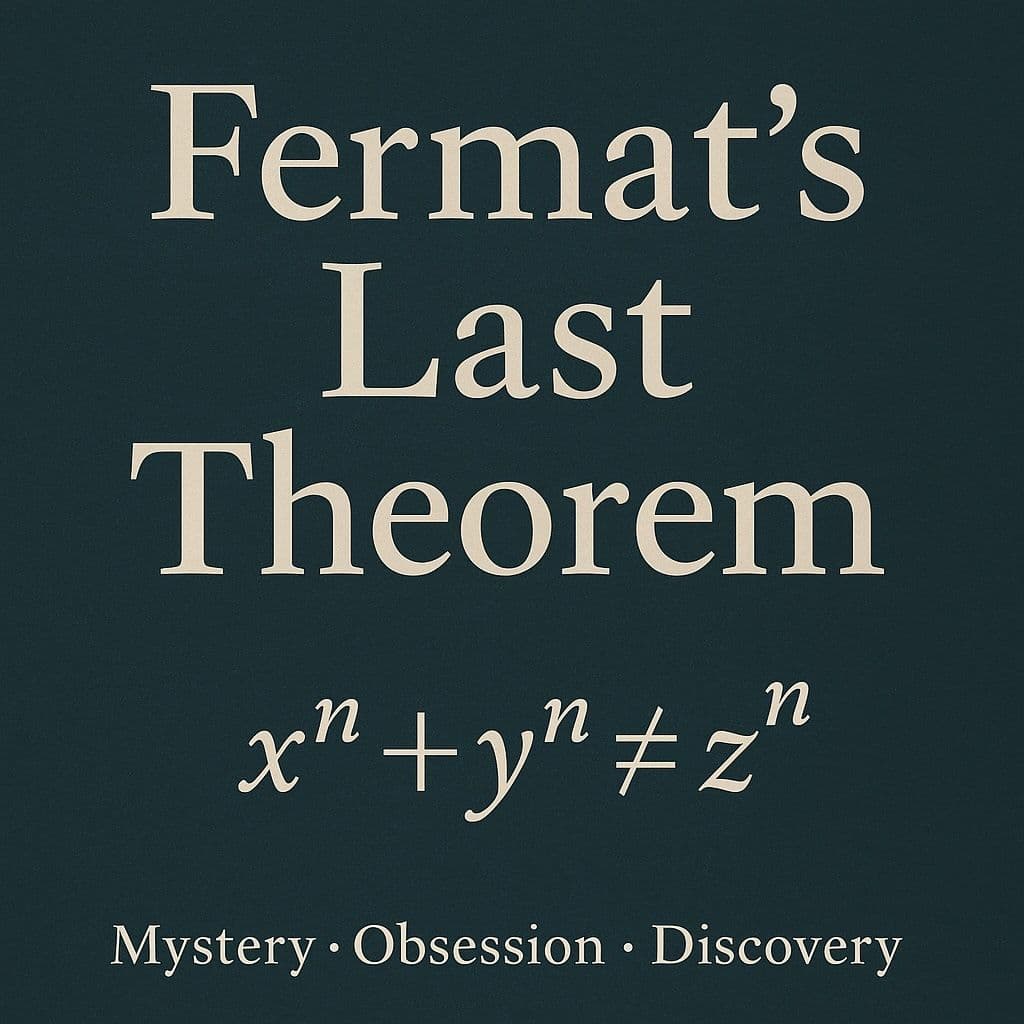
Mathematics, for all its precision and logic, has its fair share of intrigue. Few stories in mathematical history are as captivating as that of Fermat's Last Theorem-a problem that tantalized generations of mathematicians, sparked countless failed proofs, and wasn't officially solved until more than 350 years after it was first written. But what exactly is this famous theorem? Why did it capture the imagination of so many? And what can it teach us today about the spirit of discovery?
This 3000-word journey will take you through the theorem’s origins, its centuries-long struggle for a proof, the eccentric characters involved, and the stunning finale that merged ancient number theory with modern abstract mathematics. Whether you're a math lover, a curious learner, or just someone who enjoys a good intellectual mystery-Fermat's Last Theorem will keep you hooked.
1. Who Was Fermat?
Pierre de Fermat was a 17th-century French lawyer and amateur mathematician. Unlike many historical figures in science, Fermat wasn't a professor or a full-time scholar. By day, he was a magistrate; by night, he scribbled insights on mathematical manuscripts. Despite not publishing widely, his ideas were profound.
He contributed significantly to calculus, probability theory, and number theory. But most notably, he had a habit of writing theorems-sometimes without proofs-in the margins of books he was reading.
One of these marginal notes became legendary:
"It is impossible to separate a cube into two cubes, or a fourth power into two fourth powers, or in general any power higher than the second into two like powers. I have discovered a truly marvelous proof of this, which this margin is too narrow to contain."
Thus was born the enigma of Fermat's Last Theorem.
2. What Does Fermat's Last Theorem Say?
Formally, it can be stated like this:
There are no three positive integers x, y, and z that satisfy the equation
for any integer value of n greater than 2.
For example:
- The equation does have solutions. These are known as Pythagorean triples like (3, 4, 5) or (5, 12, 13).
- But according to Fermat, once the exponent is 3 or higher, there are no whole number solutions for x,y,z greater than zero.
3. The Temptation of the Theorem
Why did this simple-looking equation torment mathematicians for centuries?
First, it looks easy. A high-school student can understand the statement. Yet it resisted all attempts at proof. Mathematicians found proofs for specific exponents:
- n = 3 was proved by Euler in the 18th century
- n = 4 was proved by Fermat himself using an elegant technique called "infinite descent"
- Later, n = 5, 7, and a handful of other primes were proved through immense effort
But there was no general proof for all .
4. A Mathematical Obsession
Fermat’s Last Theorem became a rite of passage for aspiring mathematicians. Over the centuries, many claimed they had solved it-some honestly, others less so. It appeared in journals, lectures, and even amateur math forums.
It wasn’t just about proving Fermat right. The theorem became a symbol of perseverance and the intellectual purity of mathematics.
In the 19th and 20th centuries, new branches of math like algebraic number theory, modular forms, and elliptic curves were partly developed in the hope of cracking this enigma.
5. The Unexpected Hero: Andrew Wiles
In the 1980s, the problem still stood. And into this picture stepped an unassuming British mathematician named Andrew Wiles.
Wiles first encountered the theorem as a 10-year-old in a library. It captured his imagination. He would go on to become a professional mathematician-but secretly, in the background, he kept returning to Fermat’s riddle.
In 1986, a major breakthrough occurred: Japanese mathematicians Yutaka Taniyama and Goro Shimura proposed a bold conjecture connecting elliptic curves and modular forms-two deep areas of mathematics that, at first glance, seemed unrelated.
If one could prove the Taniyama-Shimura conjecture (at least for a specific class of elliptic curves), Fermat’s Last Theorem would follow as a corollary.
Wiles took this as his secret mission.
6. Seven Years in Solitude
Between 1986 and 1993, Wiles worked largely in secrecy. Only a handful of people knew what he was attempting. His wife didn’t even know until close to the end.
Why the secrecy? Wiles feared that if he failed-and especially if others knew-he might be discouraged. Instead, he poured his energy into building new bridges between elliptic curves and modular forms.
Then, in 1993, Wiles stunned the world. At a lecture in Cambridge, he outlined a proof more than 100 pages long. The audience was breathless.
But...
7. The Twist: A Flaw in the Proof
After initial celebrations, mathematicians reviewing Wiles’s work found an error. A key piece in the proof involving certain Galois representations wasn’t working as expected.
Months of uncertainty followed. Was this just another near miss?
Wiles, devastated, went back to work. He struggled to fix it. Finally, in a moment of insight, with help from a former student named Richard Taylor, he found a new approach to that critical step.
In 1994, the corrected proof was published.
Fermat’s Last Theorem was finally-and officially-proven.
8. The Beauty of the Solution
Ironically, Fermat’s own "marvelous proof" almost certainly didn’t exist. The techniques used in Wiles’s proof involve 20th-century mathematics: modular forms, elliptic curves, Galois theory. None of this was known in Fermat’s time.
But the beauty of the story lies not in the simplicity of the result, but in how it connected vast, seemingly unrelated areas of mathematics.
The proof wasn’t just about solving an equation. It forged new territory and opened doors to further discoveries.
9. Legacy and Lessons
Fermat’s Last Theorem is more than a solved riddle. It's a lesson in:
- Endurance: Wiles spent 7+ years, alone, solving a problem that stumped humanity for centuries.
- Curiosity: One marginal note led to an entirely new mathematical era.
- Elegance: The journey matters as much as the destination.
- Humility: Wiles credited others, including Fermat, Taniyama, Shimura, and Taylor, for making the solution possible.
Wiles’s achievement earned him numerous honors, including the Abel Prize (often considered the "Nobel of Mathematics") in 2016.
10. Is That the End?
Mathematically, yes. But culturally, the story lives on.
Books like Fermat’s Enigma by Simon Singh, documentaries, TED Talks, and university lectures continue to revisit the tale.
And perhaps the biggest lesson? It’s a call to dream bigger. To work quietly on what you love, even if no one else believes in it. Because in that silence, sometimes history is made.
Final Thoughts
Fermat's Last Theorem stands as a towering example of the interplay between mystery and logic, curiosity and rigor. It invites us to embrace complexity, to honor persistence, and to see mathematics not just as a tool-but as an adventure.
So next time you're tempted to dismiss math as dry or lifeless, remember the note in the margin. Remember the centuries of pursuit. Remember Wiles, alone in his study, rewriting mathematical history.
Because some proofs take more than numbers-they take vision, courage, and time.