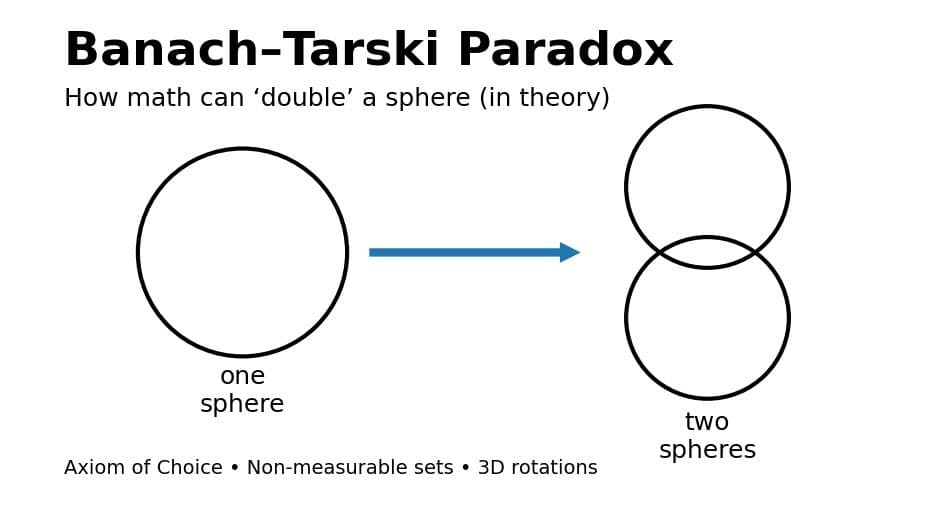
Imagine you’re holding a perfectly solid ball-say, a billiard ball made of pure, uniform material. Now imagine a mathematician walks up and says:
“I can cut that ball into a handful of pieces, rearrange them, and produce two identical balls, each the same size as the original.”
No stretching. No squishing. No melting. Just cut, shuffle, and-boom-double the ball.
If you’ve got a physics brain, you immediately protest: conservation of mass! If you’ve got a common-sense brain, you protest: that’s cheating! But mathematics calmly replies: It’s true-under certain assumptions.
This is the Banach-Tarski paradox, one of the most famous “this cannot be real” results in modern mathematics. It’s controversial not because it’s wrong, but because it forces you to confront an uncomfortable truth:
What we call “reasonable” depends on what axioms we accept.
Let’s unpack the paradox, why it works, and what it teaches us about reality, infinity, and the strange power of choosing.
The Claim, Precisely
The Banach-Tarski paradox (proved in 1924) says:
A solid sphere in 3D space can be decomposed into finitely many disjoint pieces, which can then be moved by rotations and translations (no deformation) to form two spheres identical to the original.
“Finitely many” is already a shock. Not infinitely many dust specks-just a finite number of “pieces.”
But there’s a catch. There is always a catch.
The “pieces” are not the kind of pieces you can cut with a knife. They’re not smooth chunks, not measurable blobs, not even shapes with well-defined volume in the everyday sense. They are wild sets-collections of points so intricately scrambled that “volume” stops behaving like a normal quantity.
So the paradox isn’t a magic trick with physical matter. It’s a theorem about sets of points in 3D space.
And it’s real mathematics.
Why This Feels Impossible
In everyday geometry, volume behaves nicely:
- If you split an object into parts, the total volume is the sum of the parts.
- If you move the parts around rigidly, volume doesn’t change.
- Therefore, rearranging parts shouldn’t change total volume.
This reasoning is correct-for objects whose parts have well-defined volume.
The paradox exploits the fact that not every subset of space has a meaningful volume consistent with those rules.
So the emotional punch of Banach-Tarski comes from this clash:
- Your intuition assumes everything can be assigned a volume.
- The theorem says: No. Not if you also want certain other properties.
This is where the controversy lives: not in the logic, but in the axioms.
The Secret Ingredient: The Axiom of Choice
The engine behind Banach-Tarski is something called the Axiom of Choice (AC).
In one friendly form, it says:
Given any collection of nonempty sets, it’s possible to choose one element from each set-even if there are infinitely many sets and no explicit rule for choosing.
That sounds harmless. You use choice all the time:
- Choose one sock from each drawer.
- Choose one representative from each equivalence class.
- Choose one number from each interval.
But AC allows choices so vast and so rule-less that they produce objects you can’t explicitly describe.
Think of it like this:
- Without AC, you often need a recipe for choosing.
- With AC, you’re allowed to say “I choose one from each,” even if no recipe exists.
Banach-Tarski needs exactly that kind of “non-constructive” choosing.
So one philosophical response is:
“Fine, but that’s not real. You can’t actually build those pieces.”
Mathematics replies:
“Correct-you can’t explicitly build them. But their existence follows from the axioms you accepted.”
That’s the point. Banach-Tarski is a mirror held up to your assumptions.
How Can Rearranging Points Duplicate a Sphere?
To understand the mechanism without drowning in technicalities, you only need one big idea:
In 3D, rotations can create “paradoxical” point groupings.
The paradox is deeply tied to the structure of the rotation group in three dimensions. Inside the set of all rotations of a sphere, there exist subgroups that behave (in a precise algebraic sense) like free groups-systems where combining generators creates endlessly many distinct elements with no simplifying relations.
A free group is like a machine that produces infinite complexity out of a couple of moves.
And here’s the key:
that algebraic “infinite complexity” can be transferred into geometry.
Roughly:
Consider the sphere.
Let a group of rotations act on it.
Partition the sphere into orbits under that group action.
Use the Axiom of Choice to pick one representative from each orbit.
Build sets from these representatives so that the group action replicates them in a “two-for-one” way.
What you end up with are pieces that are, in a sense, self-replicating under rotations.
If that sounds like it shouldn’t be possible-good. It’s precisely the kind of structure infinity allows when you stop insisting everything is nicely measurable.
The Missing Points Problem
One detail that often surprises people:
Banach-Tarski is typically proved for the sphere minus a thin set of points (like removing a countable set), and then those points are handled separately.
Why? Because some points are “fixed” under certain rotations (think of the poles under rotation about an axis), and fixed points break the orbit structure you want. Removing a small troublesome set makes the group action behave cleanly.
Then you add the removed points back into one of the pieces. In set theory, adding a countable set doesn’t rescue measurability or restore normal volume behavior-so the paradox remains.
Why It Doesn’t Work in 2D
If Banach-Tarski sounds like the ultimate geometric scandal, you might wonder:
Can I do this with a circle in the plane?
No-at least not in the same way.
In 2D, area behaves more rigidly under rotations and translations. There exists a well-behaved notion of area that can be extended in ways that prevent a Banach-Tarski-style doubling using only isometries and finitely many pieces.
In 3D (and higher), the symmetry groups are richer in the exact way needed for paradoxical decompositions. Something about three dimensions gives rotation enough “room” to generate the necessary algebraic wildness.
So this isn’t just “infinity is weird.” It’s “infinity plus 3D symmetry is extra weird.”
The Real Villain: Non-Measurable Sets
Let’s talk about volume.
In modern mathematics, the standard notion of volume in Euclidean space comes from Lebesgue measure. It behaves exactly how you want for all “reasonable” sets:
- Balls, boxes, smooth shapes: great.
- Unions of disjoint measurable sets: additive.
- Rotations/translations: invariant.
But Lebesgue measure has a built-in limitation:
Not every set is measurable.
This is not a bug. It’s a consequence of trying to keep those nice properties. If you insist on assigning a volume to every subset of while preserving additivity and invariance under motions, you run into contradictions (classic examples include Vitali sets). The Axiom of Choice guarantees that such pathological sets exist.
Banach-Tarski uses pieces that are non-measurable. Asking for their volume is like asking for the “official color” of a chess move. The question doesn’t apply.
So the paradox doesn’t say:
“Volume doubles.”
It says:
“Your intuition about volume fails for these pieces.”
And that’s a much subtler-and more interesting-lesson.
Is the Paradox “Real”?
This is where the controversy becomes philosophical.
View 1: “It’s a meaningless trick.”
People who dislike Banach-Tarski often argue:
- The pieces are not physically constructible.
- They have no volume.
- Therefore, the result is irrelevant to the real world.
That’s a fair practical stance.
View 2: “It reveals the cost of your axioms.”
Others argue the theorem is important precisely because:
- It exposes what the Axiom of Choice commits you to.
- It forces clarity about what “existence” means in mathematics.
- It teaches that intuition is not a proof.
View 3: “Mathematics is not physics.”
A mathematician might say:
- The theorem is about sets and transformations, not atoms and conservation laws.
- Physical matter is discrete at some scale; the continuum is an approximation.
- So it’s not surprising that continuum mathematics has behaviors the physical world doesn’t.
All three views can coexist. Banach-Tarski isn’t asking you to believe balls can be duplicated in your kitchen. It’s asking you to be honest about the rules you’re using when you reason about infinity.
The Deeper Message: Infinity Isn’t One Thing
Banach-Tarski is often filed under “infinity is strange,” but the real message is more refined:
There are different kinds of infinity, and different ways infinite structures interact with symmetry, choice, and measurement.
The paradox arises because three big ideas collide:
The continuum: space modeled as uncountably many points.
Symmetry groups: rotations and translations with rich algebraic structure.
Choice: the ability to select representatives from infinitely many orbits without a rule.
Remove any one of these, and the paradox collapses.
- No continuum → physical atoms prevent arbitrary partitions.
- No Axiom of Choice → those pathological sets might not exist.
- Restrict symmetries → fewer ways to “replicate” pieces.
So Banach-Tarski isn’t a standalone oddity. It’s a pressure test for your foundations.
Why You Should Love This Paradox (Even If You Hate It)
The Banach-Tarski paradox is not a party trick. It’s a philosophical instrument.
It shows you that:
- “Obvious” is not the same as “true.”
- “Volume” is not a universal property; it’s a carefully constructed concept with a domain of validity.
- Foundational assumptions matter, and they can have surprising consequences far from where you adopted them.
And perhaps most importantly:
Mathematics isn’t a single narrative-it’s a landscape of possible worlds.
Change the axioms, and the world changes.
In one world, choice is allowed, and spheres can be duplicated (as sets).
In another, choice is restricte,d and those sets cannot be proven to exist.
Both worlds are internally consistent-mathematics becomes a study not only of truth, but of what truth depends on.