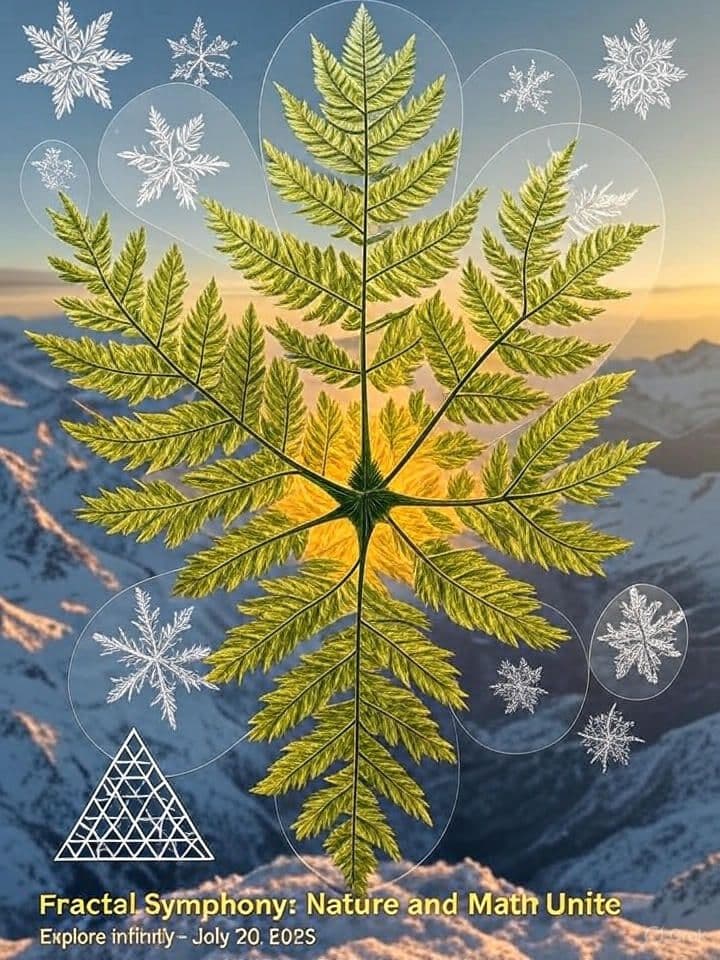
Mathematics often evokes images of rigid equations and abstract theorems, but nestled within its vast landscape lies a realm of beauty, chaos, and infinite wonder: fractals. These intricate, self-repeating patterns, uncovered through mathematical exploration, offer a mesmerizing glimpse into the structure of the universe and have captivated scientists, artists, and mathematicians since their formal recognition. As we sit at 03:08 PM MDT on Sunday, July 20, 2025, let’s embark on an in-depth journey into the enchanting world of fractals. We’ll explore their discovery, delve into their mathematical properties, marvel at their presence in nature, and uncover their surprising applications in modern technology and science. Along the way, we’ll include a fun challenge to engage you in creating your own fractal, inviting you to join this timeless mathematical adventure.
What Are Fractals?
At their essence, fractals are geometric shapes that display self-similarity, meaning they replicate their overall structure at every scale of magnification. Unlike the familiar Euclidean shapes-lines with a dimension of 1, squares with a dimension of 2, or cubes with a dimension of 3-fractals possess fractional dimensions. This fractional dimension, known as the Hausdorff-Besicovitch dimension, quantifies how a shape occupies space in a way that transcends traditional geometry. For example, a jagged coastline might have a fractal dimension between 1 and 2, reflecting its complex, non-linear path that becomes more detailed as you zoom in.
The concept of fractals wasn’t formalized until the 20th century, though early inklings appeared in mathematical history. In 1872, German mathematician Karl Weierstrass developed a function that was continuous everywhere but differentiable nowhere-a property now recognized as fractal-like. This work hinted at the existence of shapes with infinite complexity, but it was Benoit Mandelbrot who truly crystallized the idea. In his groundbreaking 1975 paper, “How Long Is the Coast of Britain? Statistical Self-Similarity and Fractional Dimension,” Mandelbrot coined the term “fractal” (from the Latin *fractus*, meaning “broken” or “fractured”). He argued that many natural phenomena—coastlines, mountain ranges, and tree branches-could be modeled using mathematics that embraced irregularity rather than forcing it into perfect shapes.
Mandelbrot’s insight was revolutionary: the length of a coastline depends on the scale of measurement. Measure it with a yardstick, and you get one length; use a finer ruler, and the jagged edges add more distance, approaching infinity as the scale shrinks. This paradox of infinite perimeter within a finite area became a defining characteristic of fractals, sparking a new field of study that blended geometry, chaos theory, and computation.
The Mandelbrot Set: A Gateway to Infinity
Among the most iconic fractals is the Mandelbrot set, a masterpiece of mathematical art and complexity. Defined by the iterative equation , where and are complex numbers and the initial , the Mandelbrot set comprises all values for which the sequence remains bounded (i.e., does not diverge to infinity). When plotted on the complex plane, this set forms a black, bulbous shape resembling a distorted snowman, surrounded by a boundary of breathtaking intricacy.
The boundary of the Mandelbrot set is where the magic happens. Colored visualizations-where hues represent the speed at which points escape to infinity-reveal an explosion of spirals, tendrils, and miniature copies of the set itself. This self-similarity is profound: zoom into any edge, and you’ll find the same patterns repeating, ad infinitum. Modern computers have explored this fractal to magnifications exceeding , uncovering details like the “Seahorse Valley” or “Elephant Valley,” named for their organic shapes. The boundary’s length is infinite, yet the area it encloses is finite (approximately 1.506 square units), a paradox that embodies the fractal’s enigmatic nature.
Calculating the Mandelbrot set relies on iterative computation, a task infeasible by hand but perfect for digital tools. Each point is tested over hundreds or thousands of iterations, determining whether it belongs to the set. This process, combined with coloring algorithms, has made the Mandelbrot set a cultural icon, gracing book covers, posters, and even music videos, symbolizing the infinite within the finite.
Fractals in Nature: A Mirror of the Wild
Fractals are not confined to mathematical abstraction; they are woven into the fabric of the natural world. The branching of a tree, where each twig mirrors the structure of the whole, exemplifies self-similarity. Snowflakes, with their hexagonal symmetry repeating at microscopic levels, are fractal in their intricate detail. Mountain ranges, with their rugged peaks and valleys, approximate fractal dimensions between 2.1 and 2.5, depending on erosion patterns.
This natural prevalence has practical implications. In biology, the fractal structure of lung alveoli-tiny, branching air sacs-maximizes surface area for oxygen exchange, with a fractal dimension around 2.97. Blood vessel networks, similarly fractal, optimize nutrient delivery across scales. In ecology, the fractal distribution of plant canopies helps model sunlight absorption. Even the human brain, with its wrinkled cortex, exhibits fractal-like folding to fit more surface area into a confined space.
Meteorologists use fractal analysis to predict weather patterns, as cloud boundaries and storm systems often follow self-similar growth. The fractal dimension of a cloud can indicate its turbulence, aiding in forecasting. This ubiquity suggests that nature employs fractals as an efficient strategy, encoding complexity with a simple underlying rule-a principle Mandelbrot called “the geometry of nature.”
The Mathematics Behind Fractals
The mathematical foundation of fractals lies in iteration and recursion. Let’s explore a few classic examples to understand this process. The Sierpinski Triangle begins with an equilateral triangle. Divide it into four smaller triangles by connecting the midpoints of each side, remove the central triangle, and repeat the process on the remaining three. After infinite iterations, the result is a pattern with holes, where the fractal dimension is . This reflects the three self-similar pieces at each step, scaled by a factor of 2.
The Koch Snowflake offers another illustration. Start with an equilateral triangle, and on each side, add a smaller triangle by erecting an equilateral triangle on the middle third and removing the base. Repeat this on each new side indefinitely. The perimeter grows by a factor of with each iteration, leading to an infinite perimeter, while the area remains finite (approaching times the original triangle’s area). Its fractal dimension, , quantifies the boundary’s increasing complexity.
These constructions rely on iterative rules, a concept that computers have made accessible. The Julia set, a cousin of the Mandelbrot set, varies the initial while keeping constant, producing diverse fractal landscapes. The mathematics of fractals, rooted in complex analysis and dynamical systems, reveals how simple equations can generate infinite variety.
Applications in Modern Science and Technology
Fractals have transcended theory to impact technology and science profoundly. In computer graphics, fractal algorithms create realistic terrains and textures. Pixar’s *Toy Story* and *The Lion King* used fractal noise to simulate natural landscapes, while video games like *Minecraft* employ procedural generation based on fractal principles. This efficiency stems from the ability to define a pattern with a single rule, then iterate it across scales.
Data compression benefits from fractals as well. Fractal image compression exploits self-similarity within images, reducing file sizes by mapping larger regions to smaller, similar ones. Though computationally intensive, this method offers high compression ratios for certain images, like natural scenes with repetitive textures.
In physics, fractals model chaotic phenomena. Turbulence in fluids, characterized by swirling eddies within eddies, follows fractal scaling laws with dimensions around 2.3. Seismologists use fractal analysis to study fault lines, where the distribution of earthquake sizes follows a power law, aiding in hazard prediction. Engineers design fractal antennas-compact, self-similar structures-that enhance signal reception across multiple frequencies, found in modern smartphones and Wi-Fi routers.
Medicine leverages fractals for diagnostics. Heart rate variability, analyzed through fractal dimensions, reveals patterns indicative of cardiac health. A lower fractal dimension might signal stress or disease, while a higher one suggests resilience. This non-invasive technique complements traditional metrics, offering new insights into complex systems.
The Role of Computing in Fractal Exploration
The digital age has been a boon for fractal study. Early calculations, like those of Mandelbrot, relied on rudimentary computers, but today’s supercomputers and software like Fractint or XaoS allow real-time exploration. The Chudnovsky brothers, known for their π calculations, also contributed to fractal computation, optimizing algorithms for massive datasets. Projects like the “Million Fractal Orbits” initiative use distributed computing to map fractal boundaries, pushing the limits of mathematical visualization.
This computational power has practical uses beyond aesthetics. Testing computer memory and processor accuracy with fractal calculations ensures hardware reliability, as the iterative nature stresses every bit. The pursuit of deeper fractal details also drives algorithm development, benefiting fields from cryptography to machine learning.
A Fun Challenge
Fractals invite hands-on exploration, and you can create one yourself! Try sketching a Sierpinski Triangle: draw an equilateral triangle, connect the midpoints of each side to form four smaller triangles, and shade out the central one. Repeat this on the remaining three triangles for a few iterations-say, three or four-and watch the pattern emerge. The result will hint at the infinite complexity achievable with more steps.
For a digital adventure, use a simple Python script with the Turtle library. Here’s a starter Python code:
import turtle

def sierpinski(length, depth):
if depth == 0:
for _ in range(3):
turtle.forward(length)
turtle.left(120)
return
sierpinski(length/2, depth-1)
turtle.forward(length/2)
sierpinski(length/2, depth-1)
turtle.back(length/2)
turtle.left(60)
turtle.forward(length/2)
turtle.right(60)
sierpinski(length/2, depth-1)
turtle.left(60)
turtle.back(length/2)
turtle.right(60)

turtle.speed(0)
sierpinski(200, 3) # Adjust length and depth as desired
turtle.done()
Run this code to draw a Sierpinski Triangle with three iterations. Experiment with the depth parameter (e.g., 4 or 5) and share your creation or iteration count in the comments-I’d love to see your fractal artistry!
The Endless Fascination
As of today, the study of fractals continues to evolve, fueled by advances in computing and our deepening appreciation of nature’s complexity. Mandelbrot’s legacy endures, his vision of fractals as a bridge between mathematics and the natural world inspiring new generations. The field intersects with chaos theory, computer science, and art, offering endless avenues for discovery.
Fractals remind us that mathematics is not just about precision but about uncovering the hidden order in chaos. Whether you’re a mathematician decoding their dimensions, an artist rendering their beauty, or a curious mind marveling at their infinity, fractals invite you to explore. The Mandelbrot set’s infinite boundary, the Sierpinski Triangle’s recursive elegance, and the fractal veins of a leaf all whisper the same truth: simplicity can birth complexity on an unimaginable scale.
What captivates you most about fractals-their visual allure, their scientific utility, or their philosophical depth? Have you tried the challenge or spotted a fractal in nature? Share your thoughts and experiences below, and let’s continue this mathematical odyssey together!