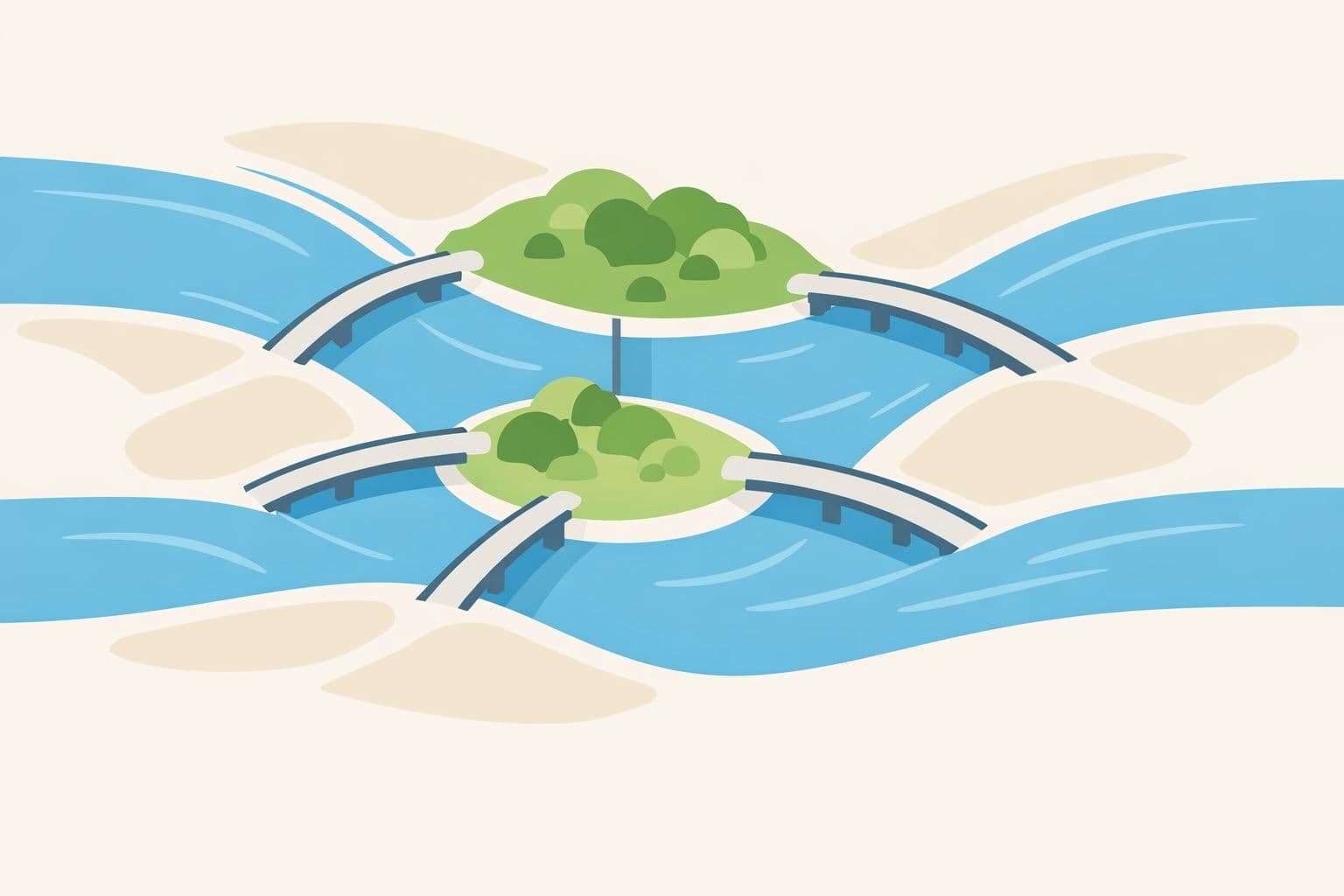
In the 1700s, the city of Königsberg (now Kaliningrad) had a casual little flex: a river that split around islands, stitched together by seven bridges. Locals turned it into a challenge:
Can you take a walk that crosses every bridge exactly once?
It sounds like a tourist game. It turned into the birth of a whole field of mathematics-graph theory-the math behind networks, routing, social connections, and the internet.
The Königsberg Bridges problem (the original puzzle)
Picture this setup:
- One river.
- Two islands.
- Two riverbanks (north and south).
- Seven bridges connect these land pieces.
You’re allowed to start anywhere. Your goal is strict:
- Cross each bridge exactly once.
- No repeats.
- No skipping.
People tried. They drew routes. They argued. And the puzzle quietly refused to cooperate.
Then Leonhard Euler showed up and did something genius: he stopped caring about the exact map.
Euler’s move: ignore distances, keep connections
Euler’s insight was almost rude in its simplicity:
- The shape of the islands doesn’t matter.
- The length of the bridges doesn’t matter.
- The curves of the river don’t matter.
Only one thing matters:
Which land areas are connected to which, and how many bridges touch each area?
So he compressed the whole city into a “skeleton”:
- Each land region becomes a node (a dot).
- Each bridge becomes an edge (a line connecting dots).
That’s a graph.
This was the birth of a new idea: you can solve a real-world navigation problem by turning it into pure connectivity.
The key concept: degree (how many bridges touch a place)
In a graph, the degree of a node is the number of edges connected to it.
Translated back to bridges:
- The degree of a land area = how many bridges lead into/out of it.
Now here’s the crucial walking fact:
Every time you enter a land area using a bridge, you must leave using another bridge… unless it’s the start or the end of your walk.
That means:
- For any “middle” land area, bridge crossings come in pairs (in + out).
- So every middle node must have an even degree.
Only the start and end points can be different:
- If you start at one node and end at another, those two nodes can have odd degrees.
- If you start and end at the same node (a loop walk), then all nodes must have even degree.
This gives the famous criterion:
- Eulerian circuit (start=end, use every edge once): all degrees even
- Eulerian path (start≠end, use every edge once): exactly two nodes have odd degree
- Otherwise: impossible
The proof is in one clean punch
Let’s prove it in plain terms.
Suppose you have a walk that uses every edge exactly once.
- Each time you arrive at a node (land area), you must also depart, because edges can’t be reused.
- So arrivals and departures pair up.
- Therefore, the total number of incident edges used at that node must be even.
The only exception:
- The starting node has one extra departure (you leave without having arrived first) → odd degree allowed.
- The ending node has one extra arrival (you arrive and don’t leave) → odd degree allowed.
So:
- If a path exists, you can have 0 odd-degree nodes (closed loop) or 2 odd-degree nodes (open path).
- If you have 4 odd-degree nodes, you’re doomed.
Apply it to Königsberg: why it’s impossible
In the Königsberg bridge layout, the four land regions have degrees:
- One region has 3 bridges
- Another has 3 bridges
- Another has 3 bridges
- Another has 5 bridges
All of these are odd.
That’s four odd-degree nodes.
But we just learned:
- You’re only allowed 0 or 2 odd nodes if you want to cross each bridge exactly once.
So the answer is not “we haven’t found the right route yet.”
It’s stronger:
No such route exists. Ever.
That’s the moment graph theory is born: a real-world question answered by a structural invariant (odd/even degrees), not by brute-force searching.
Why this tiny puzzle became huge
Euler didn’t just solve a city riddle. He introduced a new way of thinking:
Strip a problem down to its connectivity and count constraints.
That single shift powers modern systems like:
- GPS routing: roads as edges, intersections as nodes
- Internet traffic: routers as nodes, cables as edges
- Electrical circuits: junctions and connections
- Social networks: people as nodes, relationships as edges
- Biology: neural networks, food webs, gene networks
- Logistics: delivery routes, warehouse networks, airline hubs
Any time you see “things connected by links,” you’re in graph territory.
A modern mini-example you can do in your head
Say you’re designing a walking trail system in a park and you want a “cross every bridge once” challenge.
You sketch a graph and compute node degrees.
- If you want a loop walk (start=end), make every node degree even.
- If you want an open walk, allow exactly two odd nodes (start and finish).
- If you see four odd nodes, you can stop early: it’s impossible.
This is powerful because it’s a fast impossibility check. No searching, no guessing, no “maybe there’s a clever path.”
Just parity.
Key takeaways
- Euler solved the Königsberg bridges puzzle by ignoring geography and keeping only connections.
- Turning land areas into nodes and bridges into edges created the first famous graph model.
- A walk that uses every edge once requires 0 or 2 odd-degree nodes.
- Königsberg has 4 odd-degree nodes, so the route is impossible-provably.
- This idea became graph theory, powering routing, networks, circuits, and modern connectivity problems.