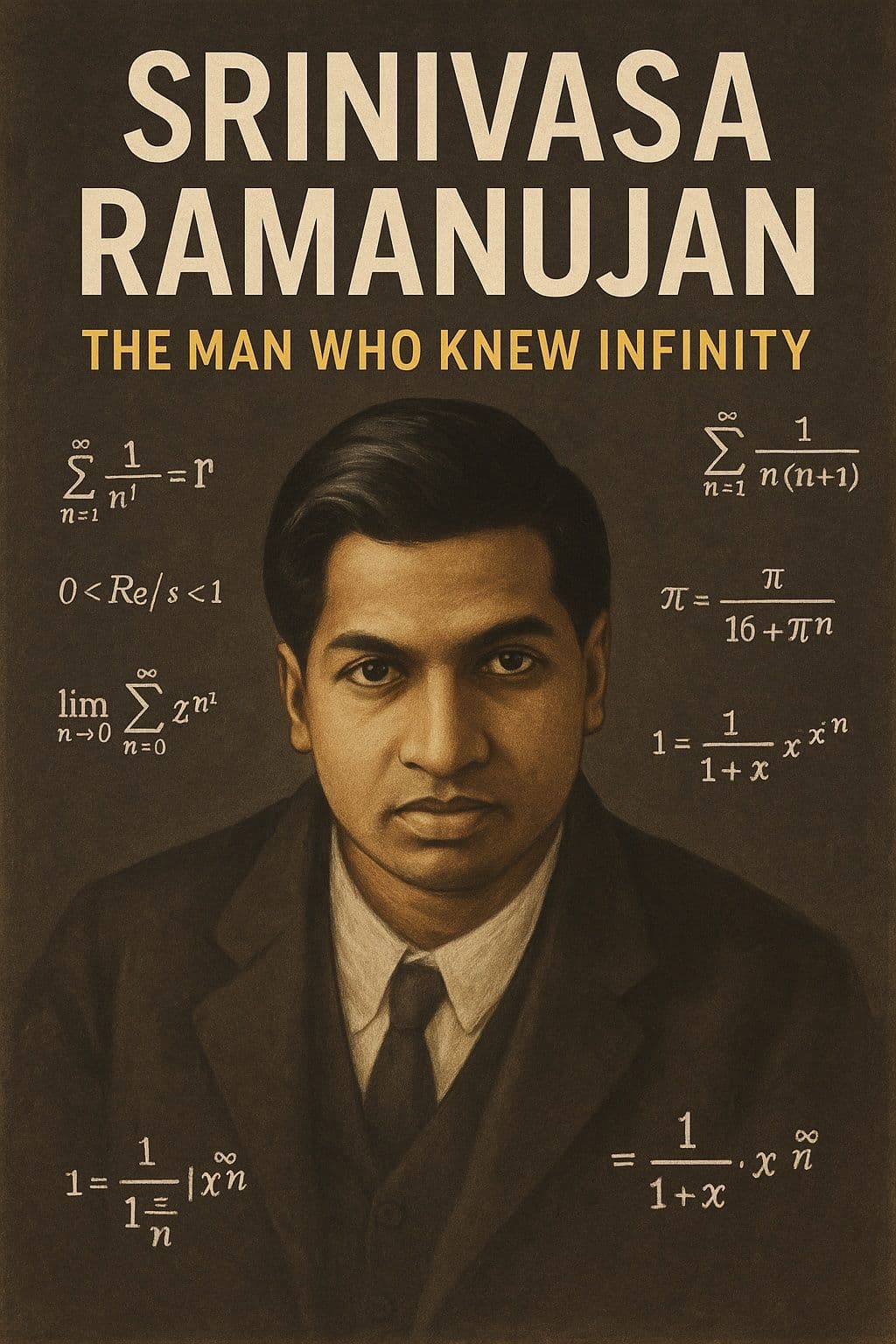
Mathematics often seems like a purely logical endeavor-calculations, theorems, and proofs neatly structured and rigorously verified. Yet occasionally, the world of mathematics is touched by individuals whose sheer intuition and genius defy conventional explanations. One of these extraordinary individuals was Srinivasa Ramanujan, a self-taught Indian mathematician whose brief but brilliant career left an indelible mark on mathematics.
Early Life and Beginnings
Born on December 22, 1887, in Erode, Tamil Nadu, Ramanujan grew up in the bustling town of Kumbakonam. He exhibited his prodigious mathematical talent at a young age, astonishing his teachers and peers by mastering advanced mathematics without any formal training. By age 13, he had independently discovered sophisticated theorems and was delving into complex mathematical texts.
Despite his obvious talent, Ramanujan faced significant barriers. Limited resources and the rigidity of the formal educational system in India made it difficult for him to pursue mathematics formally. However, Ramanujan’s passion for numbers was unstoppable. Equipped only with outdated textbooks and his relentless curiosity, he continued to explore mathematics, deriving intricate theorems that were centuries ahead of his time.
A Leap of Faith
In 1913, recognizing the limitations of his isolated environment, Ramanujan took a leap of faith by writing to several prominent British mathematicians. Among them was G.H. Hardy, a renowned mathematician at Cambridge University. Ramanujan’s letter to Hardy contained approximately 120 theorems and formulas, many of which were groundbreaking and entirely unknown in the mathematical community. Hardy was initially skeptical, yet he quickly realized the brilliance and originality contained in the letter. Impressed by Ramanujan’s insights, Hardy arranged for him to travel to Cambridge, a turning point that would shape both men's lives profoundly.
Collaboration and Genius
Arriving in Cambridge in 1914, Ramanujan began collaborating with Hardy and other eminent mathematicians. Despite the initial cultural and dietary adjustments, Ramanujan thrived in the intellectually stimulating environment. His work, characterized by intuitive leaps and profound originality, both intrigued and confounded his colleagues. He rarely provided detailed proofs, stating simply that divine intuition guided him, a notion that fascinated and bewildered his mathematical contemporaries.
During his tenure at Cambridge, Ramanujan made significant contributions to number theory, infinite series, continued fractions, and mathematical analysis. Among his most famous works is the Hardy-Ramanujan asymptotic formula for the partition function, which provides the foundation for modern combinatorics and number theory. The partition function, denoted as p(n), represents the number of ways an integer n can be expressed as a sum of positive integers, irrespective of order.
The Hardy-Ramanujan Number
Perhaps one of the most enduring anecdotes of Ramanujan's life involves what is now famously known as the "Hardy-Ramanujan number," 1729. One day, Hardy visited Ramanujan in the hospital and remarked casually that he had traveled in a rather dull taxi numbered 1729. Ramanujan, without hesitation, corrected him: "No, Hardy, it's a very interesting number. It is the smallest number expressible as the sum of two cubes in two different ways." Indeed, $1729 = 1^3 + 12^3 = 9^3 + 10^3. This incident exemplifies Ramanujan's unique and intimate relationship with numbers.
The Enigma of Ramanujan’s Intuition
Ramanujan’s method of mathematical discovery defied the conventional process of rigorous proofs and painstaking logical derivations typical in Western mathematics. Instead, he claimed inspiration from his family deity, attributing his insights to divine intervention. Hardy once described Ramanujan's intuitive approach as an unparalleled phenomenon, comparing him to legendary mathematicians such as Euler and Jacobi but noting that Ramanujan's raw intuitive power exceeded even theirs.
Modern mathematicians still grapple with understanding how Ramanujan arrived at his remarkable insights. Over a century later, his discoveries continue to be relevant, as many have found applications in diverse fields, including physics, computer science, and cryptography.
The Final Years and Legacy
Sadly, Ramanujan's health deteriorated during his years in England, exacerbated by dietary restrictions and the harsh climate. Diagnosed with tuberculosis, he returned to India in 1919. Despite his failing health, Ramanujan continued his mathematical pursuits with fervent determination. In the final year of his life, he produced some of his most profound work, known as the "mock theta functions," mysterious mathematical objects that eluded comprehension for decades after his death.
Ramanujan passed away on April 26, 1920, at the age of 32. Although his life was tragically short, his contributions were monumental. The notebooks he left behind contained a treasure trove of nearly 4000 theorems, many of which mathematicians continue to explore today.
Rediscovery and Modern Impact
The significance of Ramanujan's work has grown exponentially in recent decades. Fields such as string theory, quantum mechanics, and black hole physics have found remarkable connections to Ramanujan’s mathematics. Particularly, his "mock theta functions" have proven crucial in understanding deep aspects of quantum physics and have illuminated mysterious properties of black holes.
In 2012, the discovery of the Higgs boson particle had connections to concepts Ramanujan had anticipated a century earlier. Similarly, his work on modular forms and partitions influenced the mathematics underpinning modern cryptographic techniques, further solidifying his legacy as a visionary ahead of his time.
Ramanujan’s Cultural Impact
Beyond mathematics, Ramanujan’s life has inspired countless people across the world, becoming symbolic of the power of self-belief and intellectual passion overcoming adversity. His story has been celebrated in numerous books, documentaries, and films, most notably in "The Man Who Knew Infinity," a film adaptation starring Dev Patel as Ramanujan.
In India, Ramanujan’s birthday, December 22, is celebrated as National Mathematics Day, commemorating his extraordinary contributions and inspiring future generations to appreciate mathematics.
Conclusion
Srinivasa Ramanujan’s journey from a small town in India to the hallowed halls of Cambridge University exemplifies the boundless possibilities of human curiosity and intellect. His intuitive approach to mathematics continues to challenge and inspire mathematicians, scientists, and students worldwide.
Ramanujan remains a testament to the profound beauty and mystery inherent in mathematics. In his own words, "An equation for me has no meaning unless it expresses a thought of God." His legacy endures not just in the remarkable discoveries he made, but also in the ongoing quest to understand the infinite possibilities hidden within numbers, a quest he undertook with unmatched passion and profound insight.