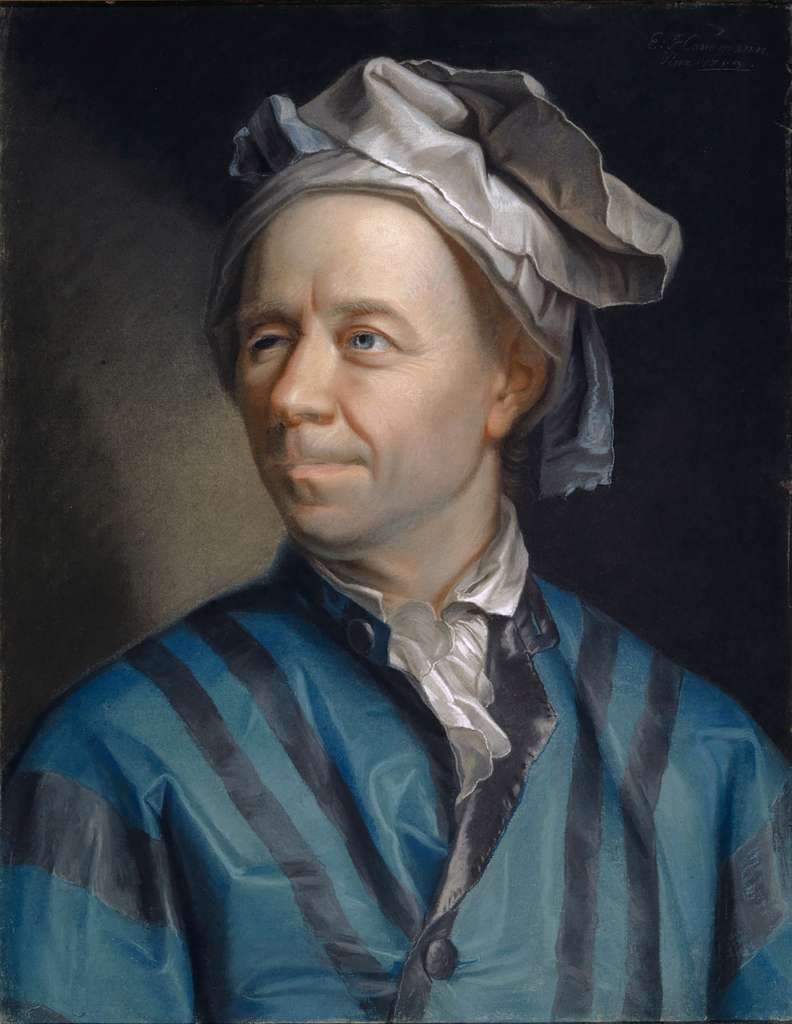
Leonard Euler, born on April 15, 1707, in Basel, Switzerland, is revered as one of the most prolific mathematicians in history. His contributions to the fields of mathematics and physics are monumental, ranging from introducing much of modern mathematical terminology and notation to pioneering work in areas such as calculus, graph theory, and topology.
Early Life and Education
Leonard was the first of two children to Paul Euler, a pastor of the Reformed Church, and Marguerite Brucker, a pastor’s daughter. His early education was heavily influenced by his father’s friend, the mathematician Johann Bernoulli. Recognizing Euler’s potential early on, Bernoulli convinced Paul Euler that Leonard was destined to become a great mathematician.
At the tender age of thirteen, Euler enrolled at the University of Basel, and by the age of sixteen, he had already obtained a Master of Philosophy with a dissertation that compared the philosophies of Descartes and Newton. Under Bernoulli’s tutelage, Euler’s mathematical prowess blossomed, leading to his further studies and eventual full-scale immersion in the world of mathematics.
Prolific Contributions and Challenges
In 1727, Euler moved to Saint Petersburg, Russia, at the invitation of Catherine I of Russia, to join the newly formed St. Petersburg Academy of Sciences. Despite initially being appointed to the medical department, Euler’s focus shifted entirely to mathematics soon after his arrival. This period was marked by intense mathematical work, and Euler published extensively, despite suffering from a fever that severely impaired his eyesight in one eye.
One of Euler’s significant contributions during this time was his work on the Konigsberg Bridge Problem, which laid the foundations of graph theory and prefigured the field of topology. Euler also made substantial contributions to number theory, and his work led to the formulation of the Euler’s Totient Function and Euler’s Theorem.
In mechanics, he formulated what now are known as the Euler equations of motion. His prolific output also included pivotal texts in mathematics that are still studied today, such as his ‘Introductio in analysin infinitorum,’ a text on functions which established much of the modern mathematical terminology and notation.
Personal Struggles and Resilience
Euler’s personal life was marked by both joys and tragedies. He married twice and had thirteen children, though sadly only five survived into adulthood. His work pace did not slow even after a cataract in his good eye left him almost completely blind in 1766. Remarkably, Euler’s prodigious memory and mental calculation abilities allowed him to continue to contribute to mathematics. He could recite Virgil’s “Aeneid” from start to finish without hesitation, and could recall every page and line where each word appeared.
Later Years and Legacy
Euler spent the last two decades of his life in Russia, continuing his extensive publication in various areas of mathematics. He passed away on September 18, 1783, after suffering a brain hemorrhage. His legacy, however, endures through his enormous body of work that continues to influence various scientific fields. Euler’s works include more than 500 books and papers, and he remains a towering figure in the history of mathematics.
Euler’s ability to develop new solutions that transcended his physical limitations is a testament to his incredible resolve and his unparalleled mathematical genius. His life and work remain a profound reminder of the enduring power of human curiosity and intellect.