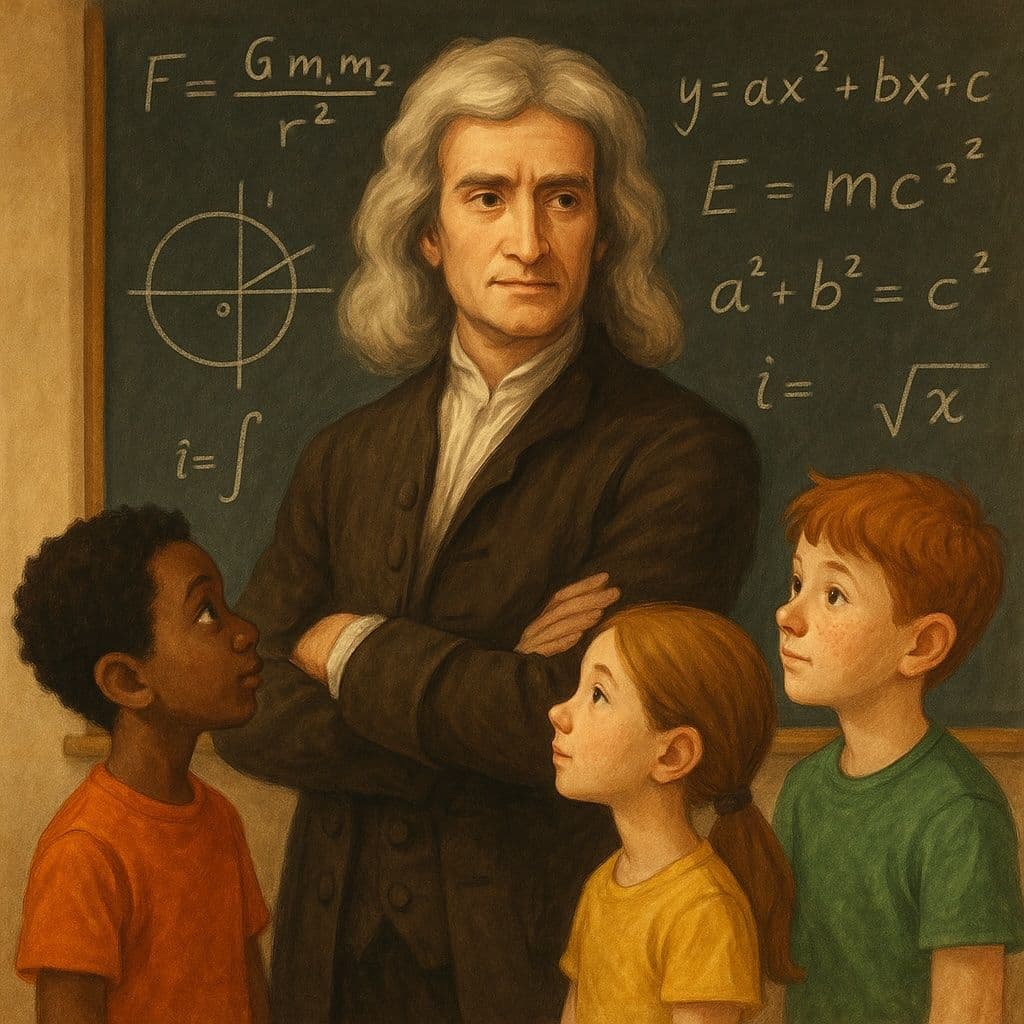
Isaac Newton is often introduced in school as “the guy with the apple” or “the father of calculus.” But behind the formulas and legends was a human being who struggled, doubted, obsessed, and—most importantly—thought deeply about what it means to learn and discover.
For young people who love (or are just beginning to tolerate!) mathematics and science, Newton’s words can be surprisingly modern. They speak about curiosity, persistence, humility, and the joy of not knowing everything yet.
In this post, we’ll look at several quotes attributed to Isaac Newton and unpack what they can mean for a young mind growing in a world of exams, grades, and endless expectations.
1. “If I have seen further it is by standing on the shoulders of giants.”
This is probably Newton’s most famous line, and it’s a perfect antidote to the pressure of being “original” at a young age.
Newton didn’t pretend he did everything alone. He built on the ideas of Kepler, Galileo, Descartes, and many others. The laws of motion and universal gravitation were revolutionary, but they came from a long chain of earlier thinkers. He knew it.
For a student, this quote changes the game:
- You don’t have to invent a new branch of mathematics at 16 to be “good at math.”
- Every time you understand a theorem, you’re climbing onto the shoulders of Gauss, Euler, Noether, and countless others.
- Asking for help, reading solutions, or learning from teachers is not a weakness-it’s exactly how progress has always happened.
In a strange way, this quote gives you permission to be a learner. Your job is not to be a lone genius. Your job is to join a conversation that started centuries ago and will continue after you.
2. “To myself I am only a child playing on the beach, while vast oceans of truth lie undiscovered before me.”
This is one of Newton’s most beautiful images.
Imagine a child on a beach, picking up shells, building small sand castles, lost in curiosity. Newton is saying: That’s me. Even after discovering calculus and gravitation, he still felt like a small child at the edge of an infinite ocean of unknown truths.
If Newton felt that way, it’s okay for you to feel overwhelmed by math or physics sometimes.
This quote teaches a few important lessons:
- Feeling small is normal. When you see a difficult problem set or a huge textbook, it’s easy to think, “I’ll never understand all this.” Newton is reminding you that nobody ever reaches “the end” of knowledge. We all stay on the beach.
- Wonder matters more than pride. The child on the beach isn’t trying to impress anyone; they’re just fascinated. Learning is much easier when you keep a sense of play.
- The unknown is a feature, not a bug. If there were nothing left to discover, science and mathematics would be dead. Your confusion today might be the starting point of tomorrow’s insight.
Next time you feel behind in math, remember: even Newton thought of himself as a beginner facing an infinite ocean. The point is not to finish the ocean. The point is to keep exploring.
3. “What we know is a drop, what we don’t know is an ocean.”
Whether or not Newton phrased it exactly this way, the idea fits perfectly with his view of science.
In school, we often experience knowledge as a checklist:
- Do you know derivatives? ✔️
- Do you know integrals? ✔️
- Do you know trigonometry? ✔️
This creates the illusion that knowledge is a box you can eventually tick as “complete.” Newton reminds us that no matter how big the drop becomes, it’s still tiny compared to the ocean.
For a young mind, this can be both intimidating and liberating:
- Intimidating, because you realize there will always be something you don’t know.
- Liberating, because you no longer have to pretend to know everything.
This quote encourages intellectual humility. You can say, “I don’t know yet,” without shame. In fact, admitting what you don’t know is the first step toward genuine learning.
And in mathematics, this attitude is crucial. Every time you hit a wall-a proof you don’t understand, a concept that feels alien-you’re simply encountering another part of the ocean. Take a breath. Take your time. Take another look.
4. “If I have ever made any valuable discoveries, it has been owing more to patient attention than to any other talent.”
We like stories about sudden flashes of genius: the apple falls, and boom, gravity! Reality is much less dramatic. Newton worked obsessively for years, rewriting and rethinking his ideas.
Here, he’s telling you that his biggest “talent” wasn’t magic intelligence-it was patient attention.
For students, that’s good news:
- You may not feel like the “smartest” person in the room.
- You may struggle at first with new topics.
- You may need more time than others to digest an idea.
But none of that disqualifies you from doing deep mathematical work. If you can develop patience-the willingness to stare at a problem, to go line by line through a proof, to try again after failing-you’re cultivating one of the core traits of a real mathematician or scientist.
In practice, that might mean:
- Spending 30 minutes on a single proof, and then revisiting it the next day.
- Re-deriving formulas instead of just memorizing them.
- Working through errors carefully instead of erasing them as fast as possible.
Newton’s message is simple and powerful: persistence beats flashiness. Patient attention is a superpower you can train.
5. “Truth is ever to be found in simplicity, and not in the multiplicity and confusion of things.”
Mathematics feels complicated only until you see the right viewpoint. Then, suddenly, everything looks simple and natural.
Newton believed that real truth often reveals itself in simpler, more unified explanations. His law of gravitation is a good example: one compact formula,
,
describes the fall of an apple and the motion of the Moon at the same time.
For young learners, this quote is an invitation to look for structure and simplicity, not just to survive the complexity:
- When you study algebra, look for patterns: why do these rules work together so nicely?
- When you study calculus, ask: what simple idea ties derivatives and integrals together?
- When a topic seems insanely messy, suspect that you might be missing a simpler underlying view.
This doesn’t mean everything feels simple immediately. It means that part of the mathematical journey is moving from confusion toward a cleaner, deeper understanding.
And this is also a good study strategy: instead of memorizing twenty formulas for special cases, try to understand the one idea that generates them all.
6. “Errors are not in the art but in the artificers.”
Roughly speaking: the problem is not in mathematics, but in us, the people trying to do it.
It sounds harsh at first, but it’s actually empowering. If you get a question wrong, it doesn’t mean math is broken or that you’re “not a math person.” It just means you made a human error-and errors can be corrected.
Newton’s quote reinforces a growth mindset:
- There is nothing “wrong” with algebra, calculus, or geometry just because they are hard.
- Your initial failure to understand them is not proof that you’re incapable.
- With better explanations, more practice, and time, you can close the gap.
In the same way that musicians practice scales and athletes practice drills, mathematicians practice making and correcting mistakes. Every error you debug is a small victory of clarity over confusion.
Seen this way, errors are not embarrassing-they’re part of the craft.
7. “I can calculate the motion of heavenly bodies, but not the madness of people.”
This one always gets a smile.
Newton is highlighting a funny contrast: the planets, with all their complexity, obey clean mathematical laws. Human beings, with their emotions, fears, and contradictions, do not.
For a young person, this quote carries a hidden message:
- Mathematics gives you a world where logic prevails and structures are consistent.
- Real life is messy-and that’s okay. Your mathematical success does not require you to be a perfectly organized, emotionless robot.
You’re allowed to be nervous before an exam, frustrated by a homework set, or overwhelmed by pressure. If even Newton found people unpredictable, you’re not alone in feeling that life is more chaotic than equations.
Paradoxically, this can make mathematics feel like a refuge: a place where reasoning can be trusted and the rules don’t shift under your feet.
8. Bringing Newton’s mindset into your own study life
Reading Newton’s quotes is interesting. Living them is transformative. Here are a few practical ways you can apply his ideas:
Stand on shoulders consciously. When you learn a theorem, look up who proved it and in what context. Realize you’re joining a centuries-long story. This makes the material feel less like random exercises and more like a living legacy.
Keep the beach image in mind. When you’re stressed about “knowing everything” for an exam, picture Newton’s child on the shore. Aim to collect a few beautiful shells (concepts you truly understand) rather than trying to own the whole ocean.
Practice patient attention. Schedule small “deep work” blocks for math: 25–40 minutes of undistracted problem-solving. No phone, no multitasking. Just you and the problem.
Seek simplicity after the struggle. After you solve a hard problem or finish a topic, ask yourself: “Can I explain the core idea in one or two sentences?” That’s Newton’s simplicity test.
Normalize errors. Start a “mistake journal” where you write down errors that taught you something important. Treat them as trophies, not scars.
Conclusion: Newton as a companion, not a statue
It’s easy to put Isaac Newton on a pedestal as an unreachable genius. But his own words reveal someone who:
- Felt like a child before an ocean of unknowns,
- Knew he depended on the work of others,
- Valued patience over raw talent,
- Searched for simplicity beneath complexity,
- And accepted that errors and confusion are part of the process.
For young minds stepping into the world of mathematics and science, Newton doesn’t have to be a distant, intimidating figure in a wig. He can be a quiet companion whispering:
- You don’t have to know everything yet.
- You are allowed to learn from others.
- Your patience matters more than your speed.
- The beauty of truth is often simple-and it’s waiting for you to uncover a tiny piece of it.
If you keep these ideas close while you wrestle with equations and theorems, then Newton’s legacy is not just in the laws of motion. It’s in the way you learn to think, to persist, and to wonder.