If you were ever told that you “can’t take the square root of a negative number,” then complex numbers are the mathematical plot twist you’ve been waiting for.
Complex numbers take that forbidden operation, , and turn it into a powerful tool that underpins modern engineering, physics, and even computer graphics. In this post, we’ll walk through where complex numbers came from, what they actually are, and why they’re so incredibly useful.
1. The Problem That Wouldn’t Go Away
The story starts with a simple equation:
.
Over the real numbers, this has no solution, because for any real . For centuries, this was just one of those “no solution” cases… until people started pushing algebra further.
In the 16th century, mathematicians like Scipione del Ferro, Niccolò Tartaglia, and Gerolamo Cardano were obsessed with solving cubic equations (degree 3 polynomials). Cardano published methods for solving general cubic equations in his famous book Ars Magna (1545).
The cubic formula (yes, there is one!) sometimes produced expressions like
,
even when the final answer was a perfectly real number. This was deeply unsettling: you had to go through “non-real” territory to reach a real solution.
Then came Rafael Bombelli, who did something bold: instead of treating these weird square roots of negative numbers as nonsense, he decided to work with them formally-like algebraic objects that obey consistent rules. He introduced something essentially equivalent to our modern imaginary unit , defined by
.
Bombelli didn’t have the modern geometric interpretation, but he understood something crucial: even if these entities looked “imaginary,” they followed algebraic rules that could be manipulated consistently-and they helped solve real problems.
2. From “Imaginary” to Fundamental: Euler and Gauss
For a while, these numbers were called “imaginary” almost as an insult. René Descartes coined the term to contrast them with “real” numbers. Many mathematicians were suspicious of them.
Things changed when Leonhard Euler and Carl Friedrich Gauss entered the scene.
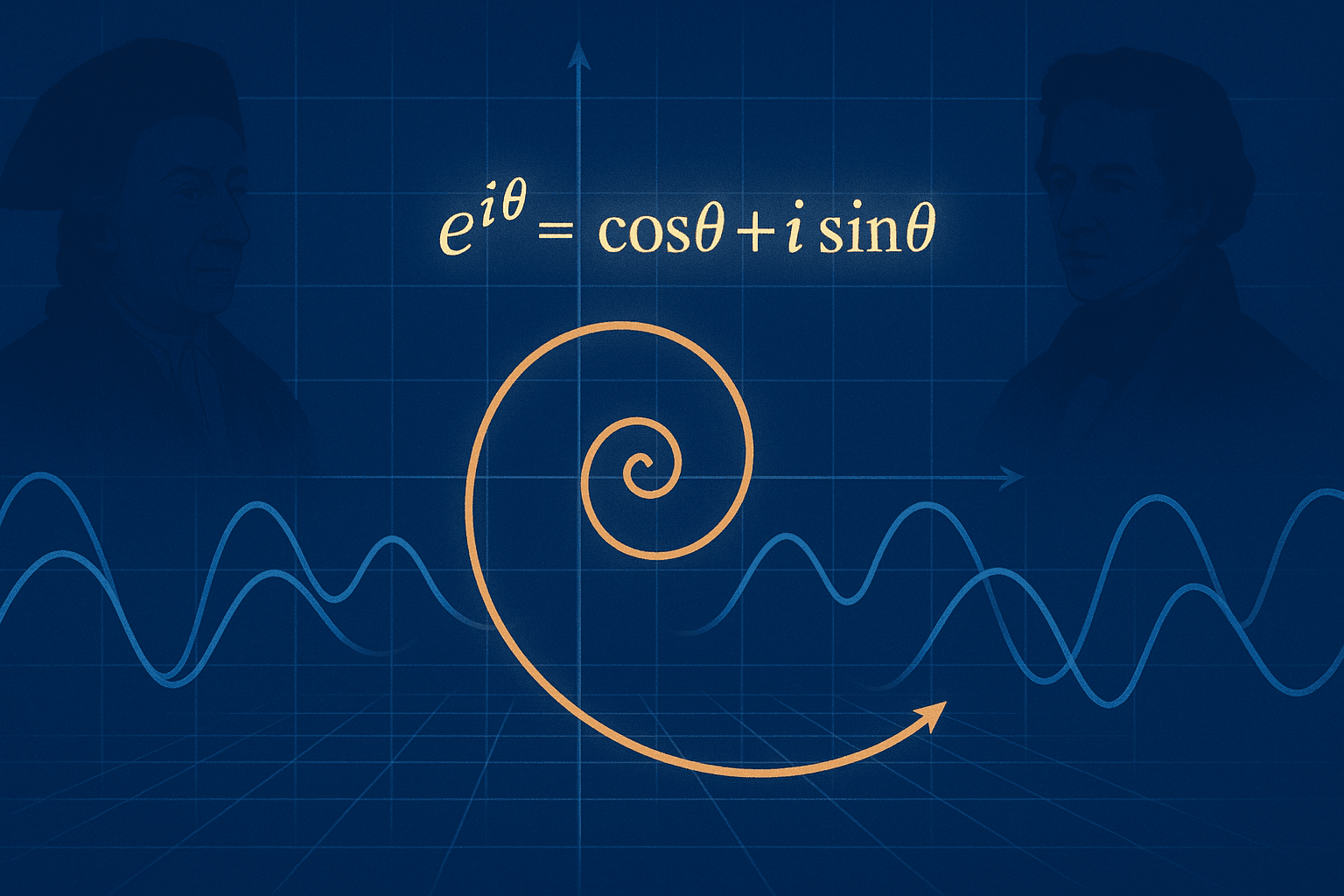
Euler discovered one of the most beautiful formulas in all of mathematics:
.
This is not just a mysterious identity-it connects exponential functions, trigonometry, and complex numbers in a single stroke. When you set , you get the famous Euler’s identity:
,
which ties together five of the most important constants in mathematics: , and .
Gauss took things further by treating complex numbers as points in a plane. Instead of thinking of them as weird algebraic symbols, he pictured a complex number
as a point with coordinates . This turned “imaginary” numbers into something geometric and concrete. That 2D plane is now called the complex plane or Argand plane (after Jean-Robert Argand, who also described it).
At that moment, complex numbers stopped being a suspicious trick and became a natural extension of the real numbers-a 2D number system.
3. What Exactly Is a Complex Number?
Formally, a complex number is written as
,
where:
- is the real part, ,
- is the imaginary part, ,
- and is the imaginary unit with .
You can:
- Add complex numbers componentwise: .
- Multiply them using the distributive law and .
Geometrically, the real part is the horizontal coordinate and the imaginary part is the vertical coordinate. So the complex number is the point .
The magnitude (or modulus) of is
,
and the argument is the angle the line from the origin to makes with the positive real axis, so that
.
Using this, any nonzero complex number can be written in polar form:
.
This polar form is where the magic really starts.
4. Rotations, Waves, and Euler’s Formula
In the real world, we often deal with oscillations and rotations: waves, alternating current, planetary motion, sound, light. Complex numbers let us describe all of these elegantly.
Consider multiplying a complex number by . Using Euler’s formula,
.
Multiplying by , we get
.
Geometrically, this means:
- The magnitude stays the same.
- The angle increases by .
In other words, multiplying by is a rotation by angle in the complex plane.
This is incredibly useful. Instead of working with 2D vectors and rotation matrices, we can rotate vectors with a single complex multiplication.
Complex numbers also simplify the description of oscillations. A cosine wave
can be seen as the real part of a complex exponential:
.
This trick, representing real oscillations as the real part of complex exponentials - , is at the heart of Fourier analysis, signal processing, and many areas of physics.
5. Why Complex Numbers Are So Useful
Let’s look at a few concrete ways complex numbers show up in real-world applications.
5.1 Solving Polynomial Equations
One of the biggest breakthroughs involving complex numbers is the Fundamental Theorem of Algebra, which (roughly) says:
Every non-constant polynomial with complex coefficients has at least one complex root.
Over the complex numbers, every polynomial of degree n has exactly n roots, counting multiplicities. This makes the complex numbers an “algebraically complete” number system.
For example, the polynomial
has no real roots, but in the complex numbers it has exactly two:
.
This completeness is one reason why complex numbers are the natural home for algebra.
5.2 Electrical Engineering and AC Circuits
If you’ve ever looked at alternating current (AC) circuits, complex numbers are everywhere.
Suppose we have a sinusoidal voltage
.
Engineers represent this as a phasor:
,
and treat circuit elements like resistors, capacitors, and inductors as complex impedances:
.
Ohm’s law becomes
,
where are complex numbers. All the messy differential equations turn into simple algebra with complex numbers, and the real physical signals are recovered by taking real parts at the end.
Without complex numbers, AC analysis would be much more cumbersome.
5.3 Signals, Images, and the Fourier Transform
In signal processing, the Fourier transform expresses a signal as a sum (or integral) of complex exponentials:
.
Here both and may be complex-valued. Complex exponentials serve as the “building blocks” of signals, and the Fourier transform tells us how much of each frequency is present.
This is used in:
- Audio compression (MP3),
- Image compression (JPEG uses a related cosine transform),
- Solving differential equations,
- Quantum mechanics,
- And much more.
Complex numbers make it natural to encode both amplitude and phase information in a single object.
5.4 Quantum Mechanics
In quantum mechanics, the state of a system is described by a wavefunction , which is complex-valued. Probabilities come from the magnitude squared , but the complex phase carries crucial information about interference and evolution.
The Schrödinger equation, which describes how quantum states evolve, is written using complex wavefunctions:
,
where is the Hamiltonian operator. Without complex numbers, the entire formalism of quantum mechanics would need to be rebuilt.
5.5 Fractals and Computer Graphics
Complex numbers also show up in the visually stunning world of fractals, like the Mandelbrot set. Consider the iteration
,
where and is a complex parameter. The Mandelbrot set consists of all complex numbers for which the sequence stays bounded.
Zooming into this set reveals infinitely intricate patterns. Many fractal images and computer-generated art rely on complex arithmetic.
6. Complex Numbers as a Natural Extension
Perhaps the most important philosophical argument in favor of complex numbers is this: they don’t break mathematics; they complete it.
- Real numbers extend the rationals to fill in gaps (like ).
- Complex numbers extend the reals to solve all polynomial equations.
- They turn rotations and oscillations into simple exponentials.
- They unify algebra, geometry, and analysis in elegant ways.
And despite the word “imaginary,” complex numbers are as real to scientists and engineers as voltages, forces, and probabilities.
7. A Quick Summary
Let’s recap the journey:
Historical origins: Complex numbers emerged from attempts to solve cubic equations. Bombelli treated as a legitimate object, even when others were skeptical.
Geometric insight: Euler and Gauss connected complex numbers to trigonometry and geometry, showing that they live naturally in a 2D plane.
Algebraic power: With complex numbers, every polynomial equation has the full set of roots-this is the Fundamental Theorem of Algebra.
Practical applications:
- AC circuit analysis and phasors,
- Signal processing and Fourier transforms,
- Quantum mechanics,
- Fractals and computer graphics.
Conceptual unity: Complex numbers unify rotation, oscillation, growth, and waves under the compact notation of complex exponentials like .
So the next time someone calls complex numbers “imaginary,” you can smile and say: imaginary or not, they run our power grids, compress our music, simulate our quantum experiments, and generate some of the most beautiful images in mathematics.