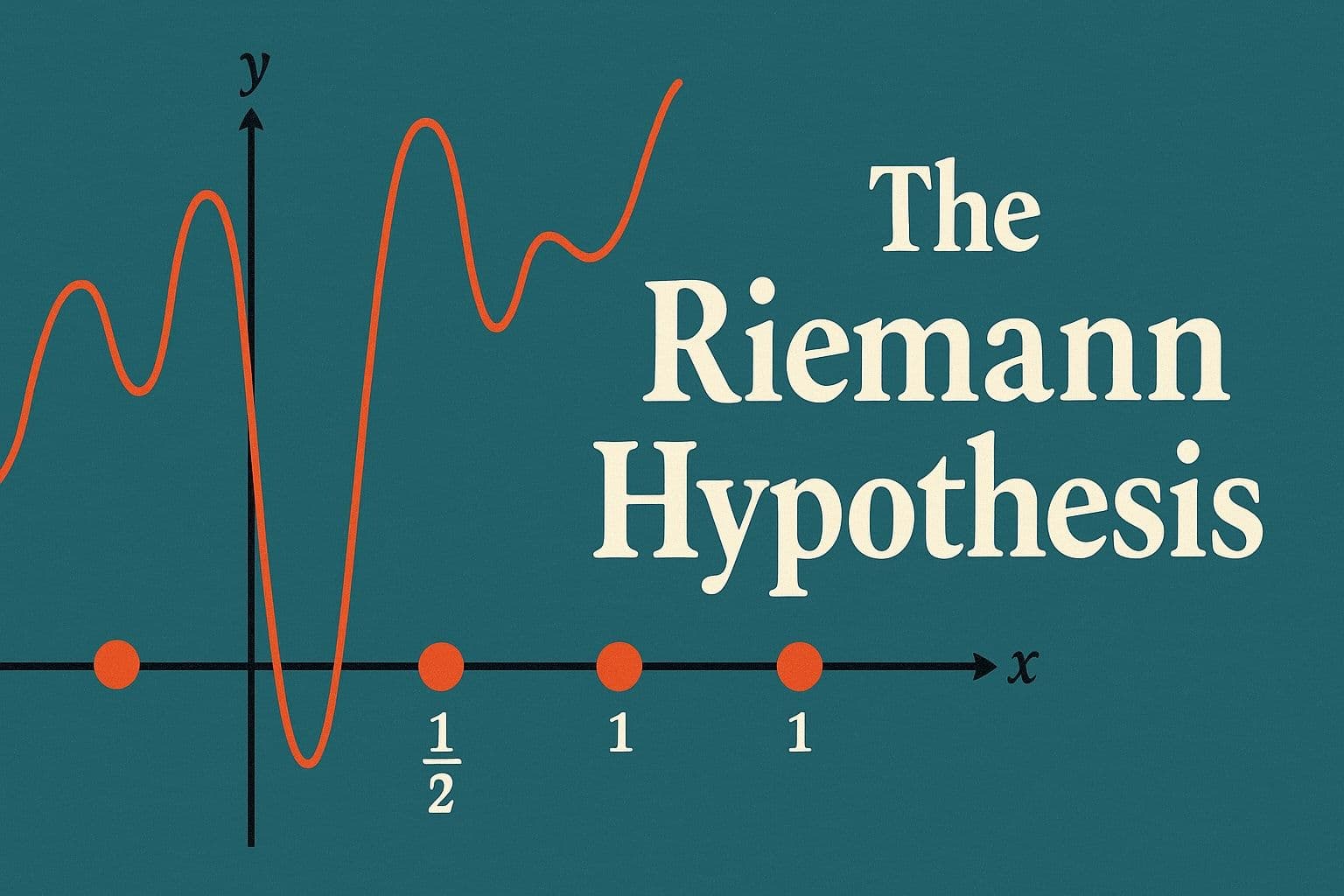
For over 160 years, mathematicians have been entranced by one of mathematics' greatest unsolved mysteries: the Riemann Hypothesis. Proposed by Bernhard Riemann in 1859, this conjecture lies at the heart of number theory and has profound implications throughout mathematics, physics, and cryptography.
The Origin of the Problem
Bernhard Riemann, a shy and brilliant mathematician, introduced his hypothesis in an eight-page paper titled "On the Number of Primes Less Than a Given Magnitude." While investigating the distribution of prime numbers, Riemann considered a complex function now known as the Riemann zeta function, ζ(s), defined for complex numbers s with real parts greater than 1 by:
Riemann brilliantly extended the definition of this function to all complex numbers (excluding s = 1) using a technique known as analytic continuation.
The Statement of the Riemann Hypothesis
The hypothesis itself is deceptively simple:
All nontrivial zeros of the zeta function have a real part equal to 1/2.
This means if ζ(s) = 0 and s ≠ -2, -4, -6..., then the real part of s is exactly 1/2. These nontrivial zeros are thus presumed to lie precisely on a vertical line, known famously as the "critical line," at Re(s) = 1/2.
Why Does It Matter?
The distribution of prime numbers, often called the atoms of arithmetic, is deeply intertwined with the Riemann Hypothesis. The prime number theorem, proven independently by Hadamard and de la Vallée Poussin in 1896, describes how primes become less frequent as numbers grow larger. However, the Riemann Hypothesis provides an even deeper, exact insight into the intricate nature of prime distribution.
If true, the Riemann Hypothesis would imply extraordinarily precise bounds on the error terms in prime-counting functions, significantly refining our understanding of primes.
Implications Beyond Number Theory
The Riemann Hypothesis is not confined solely to number theory. Its validity resonates in quantum mechanics, chaos theory, and even cryptography. Physicists have observed striking similarities between the zeros of the zeta function and the energy levels of quantum chaotic systems. This connection, explored by researchers like Michael Berry and Hugh Montgomery, hints at a deep, mysterious relationship between seemingly disparate fields.
Attempts and Progress
Over the decades, the Riemann Hypothesis has withstood relentless assaults from mathematicians worldwide. Remarkable advances have been made:
- Hardy and Littlewood: They established important groundwork on the distribution of zeros.
- Selberg and Levinson: Improved our understanding, proving that a significant proportion of zeros lie precisely on the critical line.
- Modern Computational Efforts: Computer-based analyses have verified trillions of zeros, all aligning perfectly with Riemann's conjecture.
Yet, despite these advances, a definitive proof remains elusive.
Why Is It So Hard to Prove?
The Riemann Hypothesis is difficult primarily due to the complexity and subtlety inherent in the zeta function. Proving it would require an entirely new, deep understanding of complex analysis, number theory, and possibly yet-undiscovered areas of mathematics. Many mathematicians believe that its resolution will emerge from novel techniques or revolutionary ideas.
The Million-Dollar Question
In 2000, the Clay Mathematics Institute named the Riemann Hypothesis as one of the seven Millennium Prize Problems, each accompanied by a one-million-dollar prize. This designation underscores its status as one of mathematics' most significant unsolved challenges.
The Impact of a Proof
A resolution of the Riemann Hypothesis - whether proven true or false - would mark a watershed moment in mathematics. Confirmation would solidify our understanding of prime numbers, influence computational algorithms, cryptographic security, and deepen insights into fundamental physics. Conversely, disproving it would force mathematicians to radically rethink existing theories, ushering in a new era of mathematical research.
The Human Side of Mathematics
Beyond the technical complexities, the Riemann Hypothesis captures the imagination of mathematicians and the public alike, symbolizing the eternal human quest for knowledge and understanding. It exemplifies how even the most abstract mathematical ideas can resonate deeply with broader questions about the universe and our place within it.
Conclusion: An Ongoing Quest
While mathematicians continue to grapple with the intricacies of Riemann's enigmatic conjecture, the journey itself has significantly enriched our mathematical landscape. The search for truth surrounding the Riemann Hypothesis is not merely about finding an answer but about expanding the boundaries of human knowledge and creativity.
Whether the Riemann Hypothesis is resolved tomorrow or remains open for generations, it continues to inspire awe, curiosity, and innovation, ensuring its place at the heart of mathematics and beyond.