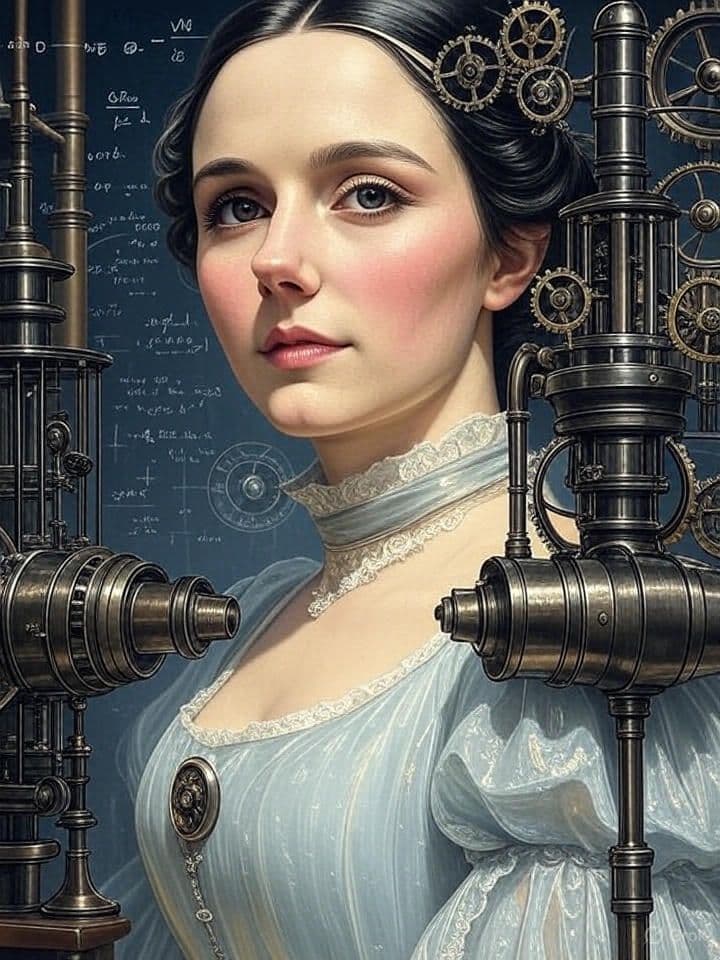
Ada Lovelace, born Augusta Ada Byron on December 10, 1815, in London, England, stands as a towering figure in the history of mathematics and technology, widely recognized as the world’s first computer programmer. The daughter of the legendary poet Lord Byron and Annabella Milbanke, Ada’s life was a remarkable fusion of artistic heritage and analytical brilliance. Her pioneering work with Charles Babbage’s Analytical Engine not only laid the foundation for modern computing but also showcased a visionary mind that saw technology as a tool for creativity and innovation. Despite a life cut short by illness, her contributions continue to inspire mathematicians, engineers, and dreamers alike, proving that genius knows no gender or era.
A Childhood Shaped by Numbers and Determination
Ada’s early years were marked by a unique upbringing driven by her mother’s ambitions. Annabella Milbanke, a woman of intellect and resolve, sought to distance Ada from her father’s poetic and volatile nature following their separation when Ada was just a month old. Lord Byron’s departure left a void, but Annabella filled it with a rigorous education in mathematics and science, subjects she believed would ground Ada’s mind. From the age of four, Ada was tutored by some of the era’s finest educators, including the logician and mathematician Augustus De Morgan. This unconventional focus fostered a deep love for numbers and logic, setting her apart from her peers.
As a child, Ada displayed an extraordinary curiosity. She once sketched a design for a flying machine, complete with detailed annotations, blending her mathematical aptitude with imaginative flair. This early blend of creativity and analysis hinted at the groundbreaking thinker she would become. Her mother’s strict regimen, though sometimes harsh, instilled a discipline that would later fuel her intellectual achievements, turning adversity into a catalyst for brilliance.
The Analytical Engine: A Collaboration That Changed History
Ada’s most significant contribution came in 1843, when she began working with Charles Babbage, a visionary inventor obsessed with creating a mechanical computing device. Babbage had designed the Difference Engine, a machine to calculate polynomial functions, and later conceived the Analytical Engine, a more advanced general-purpose computer. Ada met Babbage in 1833 at age 17, and their intellectual connection deepened over the years. In 1843, she was tasked with translating an Italian article by Luigi Federico Menabrea about the Analytical Engine. What she produced was far more than a translation—her notes, stretching to three times the length of the original text, became a landmark in technological history.
Among these notes was the first published algorithm intended for a machine: a method to calculate Bernoulli numbers using the Analytical Engine. This algorithm, though never executed on the machine (which was never built), marked Ada as the first computer programmer. But her vision extended beyond mere computation. She speculated that the Analytical Engine could manipulate symbols to compose music, produce graphics, and even mimic human creativity—ideas that were revolutionary for the 19th century and eerily prophetic of today’s software-driven world. Babbage himself acknowledged her insights, noting that she grasped the machine’s potential more fully than he did.
A Visionary Ahead of Her Time
Ada’s notes revealed a mind that transcended the limitations of her era. While Babbage saw the Analytical Engine as a tool for numerical computation, Ada envisioned it as a universal machine capable of processing any data representable by symbols. This concept foreshadowed the stored-program computer and the versatility of modern software. She wrote, “The Analytical Engine has no pretensions to originate anything. It can do whatever we know how to order it to perform,” highlighting her understanding that programming was about instructing the machine, not just feeding it numbers.
Her foresight didn’t stop there. Ada mused about the machine’s potential to influence fields like art and science, suggesting it could generate harmonic sequences for music or simulate complex natural phenomena. These ideas, penned over a century before the digital age, underscore her role as a pioneer who bridged mathematics and imagination. Her work laid the groundwork for software engineering, earning her a lasting place in computer science history. Today, Ada Lovelace Day, celebrated annually in mid-October, honors her contributions and promotes women in STEM.
Personal Struggles and Triumphs
Ada’s life was a tapestry of brilliance interwoven with personal challenges. Her health was fragile from a young age, with frequent bouts of illness that tested her resilience. As an adult, she married William King, who later became the Earl of Lovelace, and they had three children. Yet, her marriage and motherhood did not dim her intellectual pursuits. She corresponded with leading scientists and mathematicians, her letters revealing a playful yet profound intellect that often merged her poetic lineage with logical rigor.
Financial pressures also loomed large. Ada and her husband struggled with debts, leading her to gamble on horse races in a misguided attempt to recover losses. This venture, influenced by her mathematical confidence, ultimately failed, adding to her burdens. Despite these setbacks, her passion for mathematics remained unwavering. She sought to apply her skills to practical problems, reflecting a desire to make a tangible impact.
Her health declined further in her thirties, and she was diagnosed with uterine cancer. In 1852, after a painful battle, she passed away on November 27 at the age of 36, the same age at which her father had died. Buried next to Lord Byron at her request, Ada’s death marked the end of a brief but extraordinary life. Yet, her legacy endured, amplified by the rediscovery of her work in the 20th century as computers became a reality.
The Rediscovery and Enduring Impact
For decades after her death, Ada’s contributions were overshadowed by Babbage’s inventions. It wasn’t until the mid-20th century, with the advent of electronic computers, that her notes gained the recognition they deserved. Mathematicians and historians began to see her as a visionary whose ideas anticipated the programmable nature of modern technology. The “lost” depth of her annotations was unearthed, revealing theorems and concepts that aligned with contemporary computing principles.
Her influence extends beyond academia. The U.S. Department of Defense named a programming language “Ada” in her honor, a testament to her pioneering role. Her story inspires countless individuals, particularly women, to pursue careers in science and technology, breaking barriers in a field historically dominated by men. Books, documentaries, and educational programs continue to celebrate her, ensuring her name lives on as a symbol of innovation and perseverance.
A Legacy of Inspiration
Ada Lovelace’s journey is a powerful reminder that genius can emerge from unexpected places. Born into a world that rarely valued women’s intellect, she defied societal norms to leave an indelible mark on history. Her ability to blend mathematics with creativity, to see potential where others saw limitations, offers a model for anyone facing obstacles. Whether you’re a student grappling with code, an engineer designing the future, or simply someone curious about the past, Ada’s story encourages you to dream big and push boundaries.
So, take a page from Ada’s book. Explore a new problem, experiment with an idea, or dive into the history of those who came before. Her life proves that with curiosity, resilience, and a touch of imagination, you too can contribute to the grand adventure of human knowledge.