Introduction
In the early 18th century, in the heart of East Prussia, lay the bustling city of Königsberg, now known as Kaliningrad, Russia. Bisected by the Pregel River and laced with seven bridges, the city presented its citizens with an intriguing riddle. The challenge? To devise a walk through the city that would cross each bridge exactly once, without retracing any steps. The puzzle, simple in its phrasing, proved to be tantalizingly elusive.
As this problem stirred the curiosity of locals, it caught the attention of one of the greatest minds in mathematics: Leonhard Euler. Euler's groundbreaking approach not only resolved the riddle but also laid the foundational stones for an entirely new domain of mathematics. What began as a leisurely puzzle gave birth to graph theory and marked the inception of topology.
This blog post delves deep into the Seven Bridges of Königsberg problem, tracing its historical context, Euler's pioneering solution, and the revolutionary concepts it inspired. It explores how a seemingly recreational problem led to developments that underpin modern computer science, logistics, social network analysis, and more.
The City of Königsberg and Its Seven Bridges
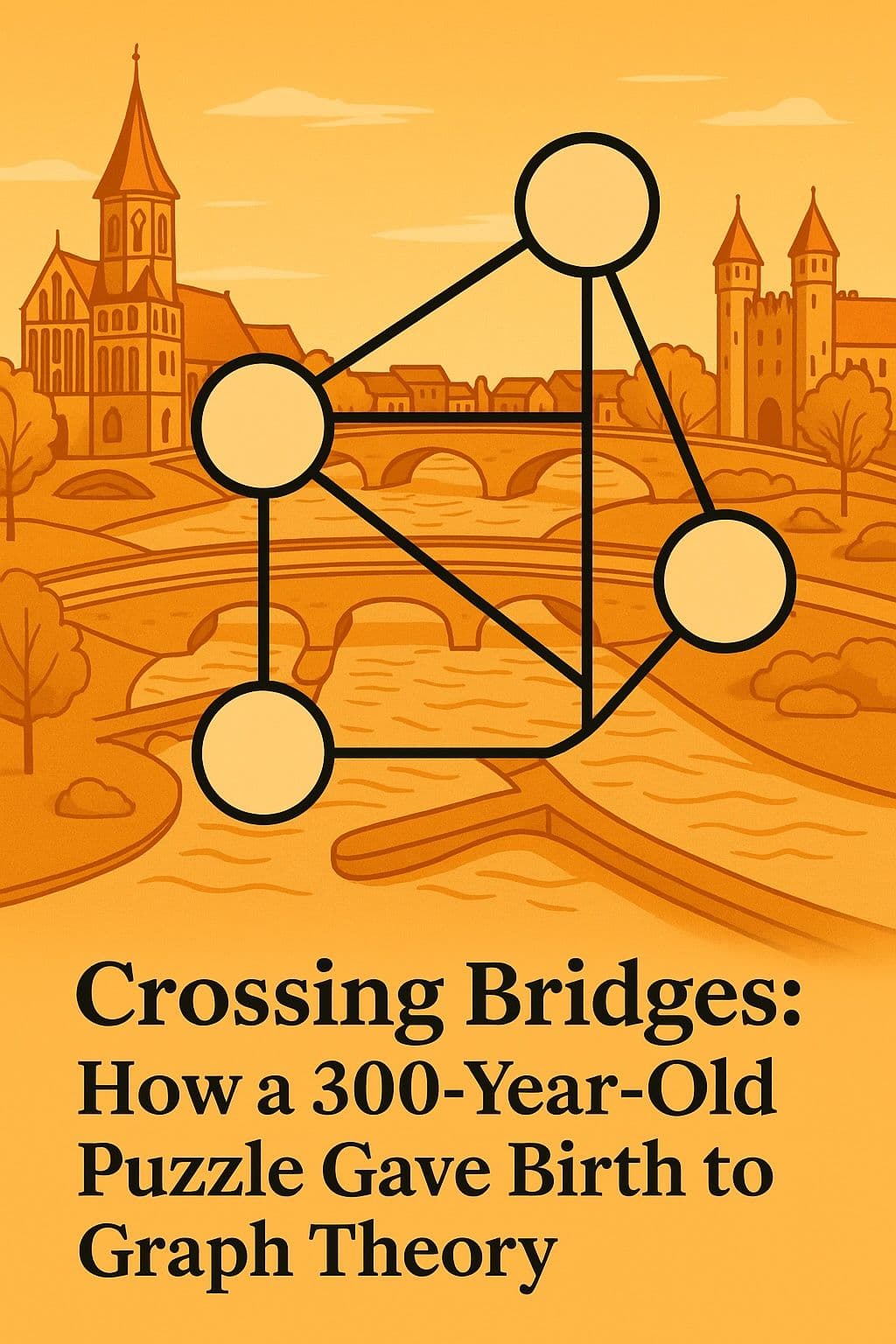
Situated on the banks of the Pregel River, Königsberg featured a distinctive topography. Two large islands, Kneiphof and Lomse, sat in the river, linked to each other and the surrounding land masses by seven bridges. These bridges connected the four land areas as follows:
- Two bridges connected Kneiphof Island to the northern bank.
- Two connected it to the southern bank.
- One bridge connected it to the other island, Lomse.
- The remaining two bridges linked Lomse to the north and south banks, respectively.
The citizens of Königsberg often pondered: Is it possible to take a stroll through the city and cross each bridge exactly once, ending at the same or a different point? Attempts to answer this question yielded no fruitful results, leading many to wonder whether such a walk was even theoretically possible.
Euler's New Perspective
Enter Leonhard Euler, a Swiss mathematician whose name today is nearly synonymous with mathematical ingenuity. When Euler was first approached with the bridge problem, he recognized its potential as more than a casual riddle. Instead of considering the geographical specifics of the city, Euler abstracted the situation entirely.
He modeled each landmass as a node (or vertex) and each bridge as a connection (or edge) between nodes. What emerged was a schematic diagram devoid of any geographical features but rich in mathematical insight.
Euler noticed something critical: the solution depended not on distances or directions but on the number of bridges connected to each landmass—a concept he formalized as the degree of a vertex.
Euler's Theorem and the Birth of Graph Theory
In 1736, Euler published his findings in the paper "Solutio problematis ad geometriam situs pertinentis" (Solution of a Problem Relating to the Geometry of Position). This work is widely regarded as the first in the field of graph theory.
Euler stated that for such a walk (now called an Eulerian trail) to exist, two criteria must be met:
The graph must be connected; that is, one must be able to reach any node from any other node via the edges.
Exactly zero or two vertices must have an odd degree.
Why is this important? Whenever a walk enters a vertex via one edge, it must leave through another. Therefore, if the number of connections (degree) to a node is odd, there will always be one unpaired edge, making a smooth traversal impossible unless it is the start or end point.
In the case of Königsberg:
- All four land areas had an odd number of bridges.
- Hence, no Eulerian trail existed.
Euler concluded, definitively, that the desired walk was impossible.
From Recreational Riddle to Mathematical Revolution
Euler's abstraction was radical. Until then, mathematics had predominantly dealt with quantities, shapes, and functions. Euler's solution required none of these-only the structure and relationships between entities.
This marked the birth of graph theory, a discipline that studies the relationships between objects. A graph consists of vertices (nodes) and edges (links), and the theory explores how these elements interact.
Additionally, Euler's ideas anticipated the development of topology, a field concerned with properties that remain unchanged under continuous deformations. Graphs are topological objects in that they remain structurally identical regardless of how they are stretched or twisted.
Expanding the Field: Key Concepts in Graph Theory
Over the centuries, graph theory has expanded to include numerous concepts, such as:
- Eulerian Path and Circuit: A path that uses every edge exactly once. A circuit starts and ends at the same vertex.
- Hamiltonian Path: A path that visits every vertex exactly once.
- Connectivity: The ability to get from one vertex to another.
- Planarity: Whether a graph can be drawn in a plane without crossing edges.
- Graph Coloring: Assigning colors to vertices so that no two adjacent ones share the same color.
Each of these concepts has far-reaching applications, from solving puzzles to designing computer algorithms.
Real-World Applications of Graph Theory
Euler could not have predicted that his playful problem would eventually find use in everything from air traffic control to molecular chemistry. Here are some major applications:
1. Computer Science
- Networking: Internet and communication networks are modeled as graphs.
- Algorithms: Graph traversal algorithms like Dijkstra's or A* are fundamental to pathfinding.
- Data Structures: Trees and graphs are key structures in data organization.
2. Logistics and Urban Planning
- Routing: Delivery companies use Eulerian circuits to optimize routes.
- Traffic Flow: Urban planners analyze intersections and traffic patterns using graphs.
3. Biology and Medicine
- Neural Networks: Brain connectivity maps are constructed as graphs.
- Epidemiology: Disease spread is analyzed using graph models.
4. Social Sciences
- Social Networks: Relationships between individuals or organizations are modeled using graphs.
- Influence Analysis: Identifying central or influential figures in a network.
5. Chemistry and Physics
- Molecular Graphs: Representing molecular structures.
- Quantum Computing: Quantum states and transitions can be modeled as graphs.
A Modern Example: The "Chinese Postman Problem"
Inspired by Euler's work, the Chinese Postman Problem asks: "What is the shortest closed path or circuit that visits every edge of a graph?" This has direct implications for mail delivery, garbage collection, and street sweeping.
Unlike Euler's binary question ("Is a path possible?"), the Postman Problem seeks an optimal solution, often requiring duplication of some edges. Algorithms developed to solve this have vastly improved route optimization techniques.
Beyond Bridges: Euler's Legacy
Euler's contributions extend far beyond graph theory. He was prolific across mathematics, publishing over 850 papers and books. His name is attached to countless formulas, theorems, and concepts:
- Euler's Identity:
- Euler's Formula for Polyhedra: V−E+F=2
- Euler's Totient Function: In number theory, it counts the integers up to a number that are coprime to it.
But the Seven Bridges of Königsberg holds a special place. It represents a turning point-the moment mathematics expanded from the quantitative to the structural. Euler took a local curiosity and revealed a universal truth.
The Philosophy of Abstraction
One of the most profound lessons from the bridge problem is the power of abstraction. By stripping away the details of Königsberg's geography, Euler revealed a deeper mathematical structure. This approach is foundational to modern science.
In physics, we abstract forces and fields. In computer science, we abstract computation. In economics, we abstract behavior. Across domains, abstraction lets us see the forest, not just the trees.
Educational Value: A Teaching Moment
The Seven Bridges of Königsberg is more than a historical anecdote. It's a powerful teaching tool:
- For Students: It illustrates how to think mathematically about real-world problems.
- For Educators: It bridges recreational puzzles and rigorous theory.
- For Researchers: It reminds us that groundbreaking insights can come from the most humble of origins.
Conclusion
Euler's exploration of a local curiosity in Königsberg opened the gates to new mathematical landscapes. The problem's simplicity belied its significance, and its resolution changed the trajectory of mathematics forever.
Today, we walk metaphorical bridges in our daily lives-navigating networks, solving logistical puzzles, understanding connections. All of this is possible because Euler dared to ask not just "Can we cross these bridges?" but "What do these bridges tell us about the structure of the world?"
So the next time you find yourself pondering a simple puzzle or pattern, remember Königsberg. Remember Euler. And remember that sometimes, the most profound discoveries begin with a walk across a bridge.
If you enjoyed this exploration of the Seven Bridges of Königsberg and want more stories about the mathematical wonders that shape our world, stay tuned for upcoming posts.