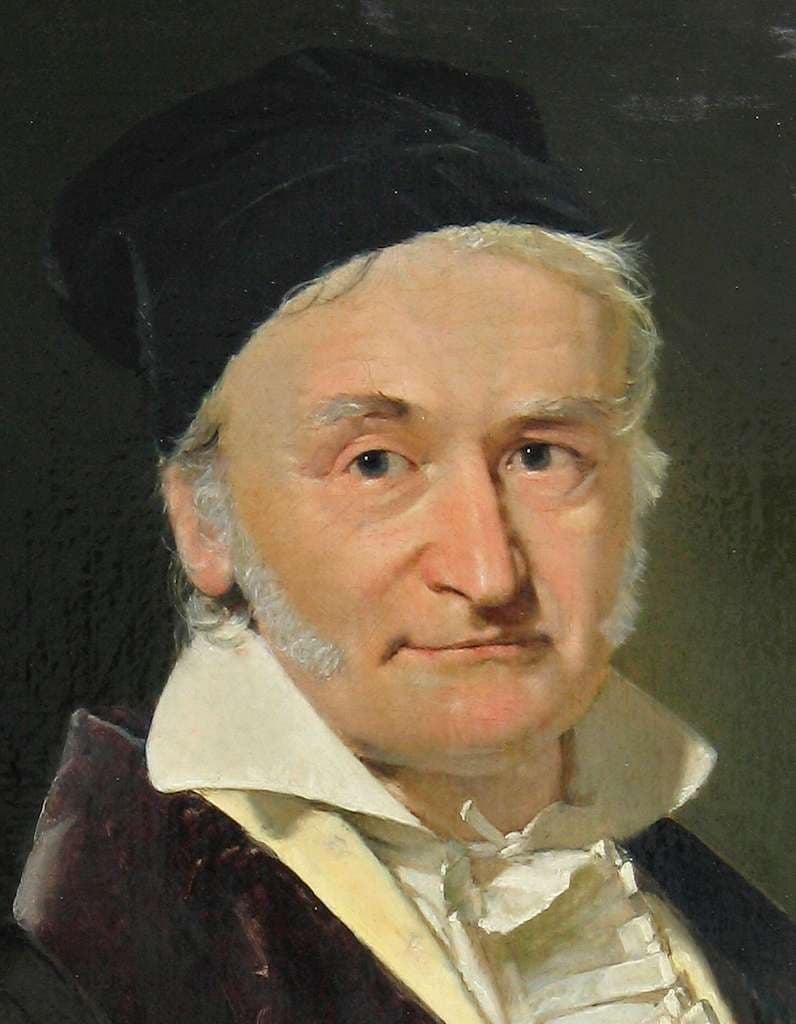
When it comes to the greatest minds in mathematics, few names shine as brightly as **Carl Friedrich Gauss** (1777–1855). Known as the *"Prince of Mathematicians,"* Gauss was a child prodigy who grew up to revolutionize fields ranging from number theory to astronomy. His work was so profound that his discoveries continue to shape modern science and mathematics. But who was Gauss, and what makes him such a legendary figure? Let’s dive into the life and legacy of this extraordinary genius.
The Child Prodigy
Gauss’s brilliance was evident from an early age. One of the most famous anecdotes about his childhood involves a math problem given by his schoolteacher. The teacher asked the class to sum all the numbers from 1 to 100, expecting to keep the students busy for a while. To everyone’s astonishment, young Gauss solved the problem in seconds. He realized that pairing numbers (1 + 100, 2 + 99, 3 + 98, etc.) would always sum to 101, and since there were 50 such pairs, the total was 5050. This clever insight foreshadowed the innovative thinking that would define his career.
A Master of Many Fields
Gauss’s contributions to mathematics and science are vast and varied. Here are just a few highlights:
1. Number Theory
At just 21, Gauss published *"Disquisitiones Arithmeticae,"* a groundbreaking work that laid the foundation for modern number theory. He introduced concepts like modular arithmetic and proved the law of quadratic reciprocity, which he called the *"golden theorem."*
2. Astronomy
In 1801, Gauss accurately predicted the orbit of the asteroid Ceres, which had been lost after its initial discovery. His methods for calculating celestial orbits are still used today.
3. Geometry
Gauss made significant contributions to differential geometry, including the development of Gaussian curvature, which is fundamental to understanding the shape of surfaces.
4. Statistics
The Gaussian distribution, also known as the *"bell curve,"* is one of the most important concepts in statistics and probability. It’s used in everything from analyzing test scores to predicting stock market trends.
5. Physics
Gauss formulated Gauss’s law, one of the four Maxwell’s equations that form the foundation of electromagnetism.
The Man Behind the Genius
Despite his towering intellect, Gauss was a humble and private man. He was known for his meticulous approach to work, often refusing to publish results until he was certain they were perfect. This perfectionism meant that some of his discoveries, like non-Euclidean geometry, were only revealed after his death.
Gauss was also deeply curious about the world beyond mathematics. He collaborated with physicists, astronomers, and even surveyed land, contributing to the development of geodesy. His ability to connect abstract mathematical ideas to real-world problems was unparalleled.
Gauss’s Legacy
Gauss’s influence is everywhere. His work underpins much of modern mathematics, physics, and engineering. The Gaussian distribution is a cornerstone of statistics, and his contributions to number theory and geometry continue to inspire researchers today. Even in everyday life, his impact is felt—whether you’re using GPS (which relies on his work in geodesy) or analyzing data (using the bell curve).
But perhaps Gauss’s greatest legacy is his approach to problem-solving. He once said, *"It is not knowledge, but the act of learning, not possession but the act of getting there, which grants the greatest enjoyment."* This mindset—curiosity, persistence, and a love for discovery—is what made Gauss a true giant of science and mathematics.
Why Gauss Still Matters Today
In a world increasingly driven by data and technology, Gauss’s work is more relevant than ever. His insights into statistics and probability are essential for machine learning and artificial intelligence. His contributions to geometry and physics continue to shape our understanding of the universe. And his story reminds us that even the most complex problems can be solved with creativity and determination.
So the next time you encounter a bell curve or use a GPS device, take a moment to appreciate Carl Friedrich Gauss—the mathematician who saw patterns where others saw chaos and whose legacy continues to illuminate the world.
Final Thought
Gauss once remarked, *"Mathematics is the queen of the sciences, and number theory is the queen of mathematics."* Through his work, he crowned himself as the prince of this royal domain, leaving behind a legacy that will inspire generations to come.