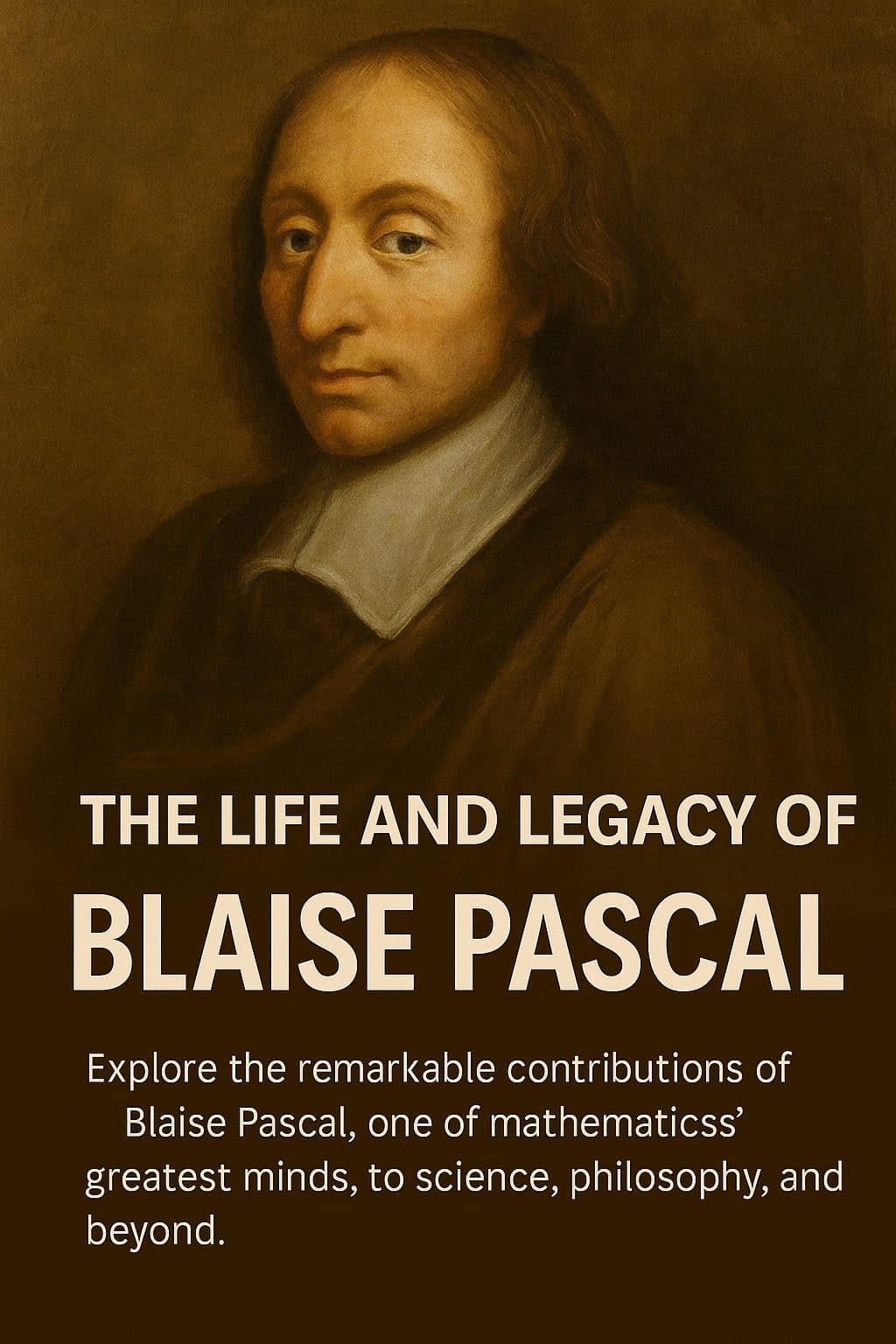
What do gambling, early computing, philosophy, and religious introspection have in common? One man: Blaise Pascal. A genius whose short life left a long legacy, Pascal stands at the intersection of logic and belief, mathematics and mysticism, science and soul.
When you hear the name Blaise Pascal, it might conjure up memories of high school math classes and something called Pascal's Triangle. But behind that famous array of numbers is a man whose intellect transcended any single field. Born in 1623 in Clermont-Ferrand, France, Pascal was a child prodigy. By age twelve, he had already discovered several geometric theorems on his own, and by sixteen, he wrote a paper so advanced that it gained the admiration of the mathematical elite in Paris.
Pascal’s early fame came from geometry, particularly his work on conic sections. At just sixteen, he published a groundbreaking essay on what would later be known as Pascal’s Theorem, relating to hexagons inscribed in conic sections. This work laid the foundation for modern projective geometry.
But Pascal didn’t stop there. His mind was too restless, too expansive. In his teens, he started exploring practical problems that most people would overlook. One such problem: his father’s struggle with laborious tax calculations. To help, Pascal invented what is considered one of the first mechanical calculators—the Pascaline. It could add and subtract using a series of gears and wheels, a forerunner to the digital age. Though it was not a commercial success in his time, it stands today as a brilliant leap toward modern computing.
His intellect also turned toward one of the most unlikely sources of mathematical innovation: gambling. Along with his contemporary Pierre de Fermat, Pascal laid the groundwork for what we now know as probability theory. They were approached by a nobleman perplexed by how to fairly divide winnings in an unfinished game of chance. The question sparked a correspondence that would change mathematics forever.
The principles they developed are the bedrock of statistics, economics, game theory, and even quantum mechanics. In a way, the world of insurance, finance, and artificial intelligence owes a strange debt to a curious nobleman's wager.
Yet Blaise Pascal's story takes a sharp turn from mathematics into something more personal, more profound. In 1654, after a near-death experience in a carriage accident, Pascal underwent a religious awakening. He abandoned most of his scientific work and devoted himself to theology and philosophy.
His most famous work from this period is the Pensées (“Thoughts”), a collection of reflections on human nature, God, and the meaning of life. In it, he presents the idea now known as Pascal's Wager. The argument goes like this: If you believe in God and you're wrong, you've lost nothing. If you don't believe and you're wrong, you've lost everything. Therefore, the rational bet is to believe.
Critics and admirers alike have debated Pascal's Wager for centuries. Some see it as an elegant blend of faith and logic. Others view it as a gamble unworthy of true conviction. But it epitomizes the way Pascal’s mind worked—always seeking clarity in uncertainty, structure in chaos, hope in mystery.
Pascal's health was fragile throughout his life. He suffered from various ailments and died young, at just 39 years old. And yet in that short time, he left an imprint across disciplines. Mathematics, physics, computer science, theology, and philosophy all claim a part of his legacy.
Today, his name endures in many ways: Pascal's Triangle, Pascal's Law (in fluid mechanics), the Pascaline calculator, the Pascal programming language, and, of course, Pascal's Wager. But more than that, Pascal remains a symbol of the human struggle to reconcile the known and the unknown, the rational and the spiritual.
In an age where specialization is often seen as the path to greatness, Blaise Pascal reminds us of the power of a mind that dares to explore it all. His life was a bridge between worlds—between the cold certainty of mathematics and the warm uncertainty of faith.
And maybe that’s the greatest lesson he offers us today: that truth is not always found in answers alone, but also in the questions we have the courage to ask.
Thanks for reading! For more stories about the fascinating lives behind the math, stay tuned to the blog.