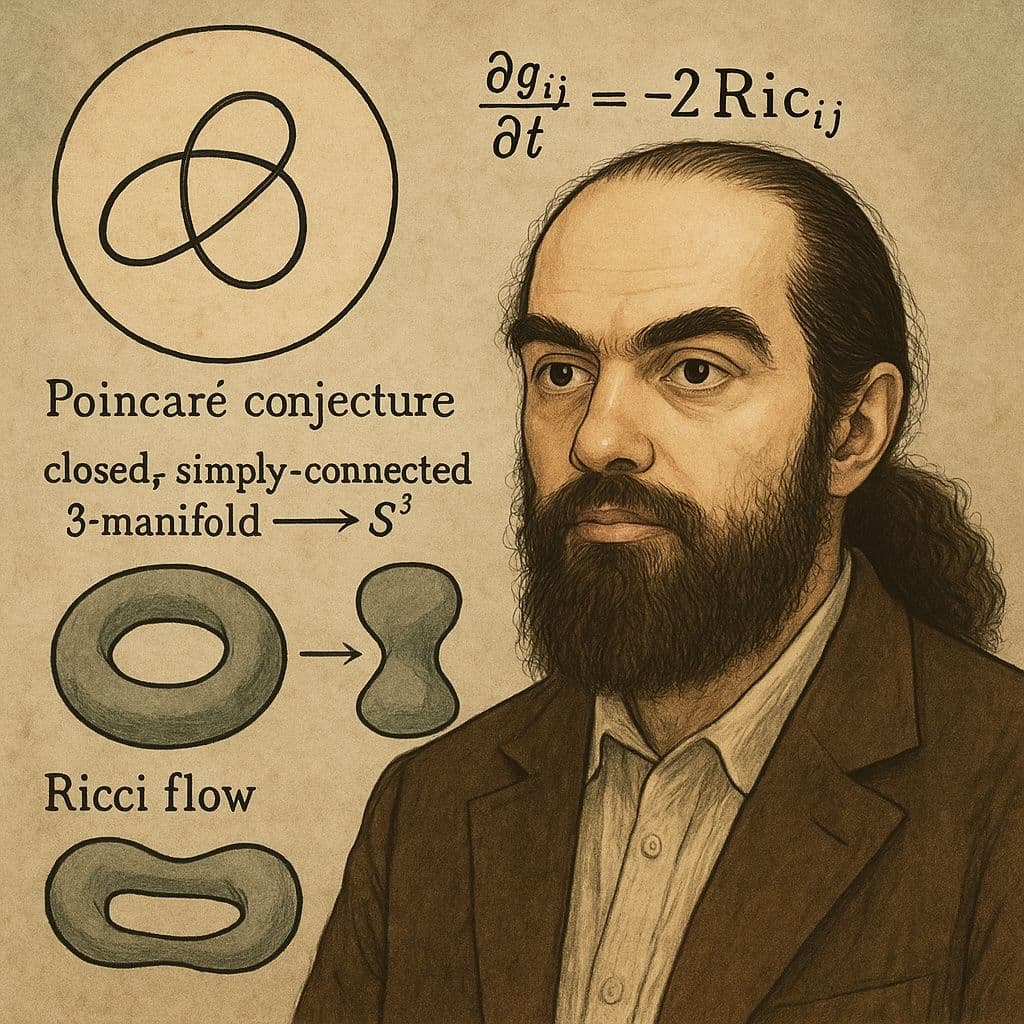
If mathematics had a legend who walked away from fame at its absolute peak, it would be Grigori Perelman.
Most people hear about him in one sentence: “The guy who solved the Poincaré conjecture and refused the Fields Medal and a million dollars.” That’s true-but it’s also a huge understatement. Perelman didn’t just solve a famous problem; he completed a grand vision about the shape of three-dimensional spaces and changed geometric analysis along the way.
Let’s unpack who Perelman is, what the Poincaré conjecture actually says, how he solved it, and why his story feels so different from most modern scientific careers.
1. From Leningrad to Legend
Grigori Yakovlevich Perelman was born in 1966 in Leningrad (now Saint Petersburg). Very early, he showed unusual talent for mathematics:
- He trained at specialized math schools in the Soviet Union.
- He won a gold medal at the International Mathematical Olympiad in 1982 with a perfect score.
- He studied and worked in the powerful Soviet/Russian school of geometry and analysis.
Colleagues describe him as extremely focused, quiet, and uninterested in anything that wasn’t mathematics. If Euler calculated “like others breathe,” Perelman gave the impression of someone who breathed only mathematics.
In the 1990s, he spent some time in the United States at leading universities. His work was already impressive-but nothing foreshadowed what would come next: an attack on one of the biggest open problems in topology and geometry.
2. What Is the Poincaré Conjecture?
The Poincaré conjecture is a statement about the topology of 3-dimensional spaces-objects that, locally, look like ordinary 3D space.
A 2D analogy helps. Think of closed surfaces:
- A sphere (like the surface of a ball),
- A torus (like the surface of a donut),
- More complicated “multi-holed” surfaces.
One way to distinguish them is by loops. On a sphere, every loop can be shrunk to a point without cutting the surface. On a torus, a loop going through the hole cannot be shrunk to a point.
Formally, a space where every loop can be contracted to a point is called simply connected.
In 3 dimensions, Henri Poincaré asked (in modern language):
If a compact 3-dimensional manifold is simply connected, is it necessarily a 3-sphere?
A 3-sphere is the 3D analogue of the ordinary sphere , but living in 4D space:
.
So the conjecture says:
Poincaré Conjecture: Every closed, simply connected 3-manifold is homeomorphic to .
“Closed” means compact and without boundary. “Homeomorphic” means you can stretch, bend, and deform one space into the other without cutting or gluing.
This is a purely topological statement, but the successful attack came from geometry and partial differential equations.
3. Geometrization: The Bigger Dream
The Poincaré conjecture is actually just one piece of a much larger conjecture due to William Thurston, called the Geometrization Conjecture.
Roughly, Thurston’s idea was that every reasonable 3-manifold can be cut into pieces, each of which carries one of a small number of standard geometric structures (like hyperbolic geometry, spherical geometry, etc.). Think of it as a kind of periodic table for 3D spaces.
- Poincaré’s conjecture is the special case: if a 3-manifold is simply connected and closed, it should belong to the “spherical” piece and be itself.
So solving Poincaré wasn’t just a one-off trick: it fit into a much deeper geometrical picture. Perelman’s work, in fact, gave a proof of Thurston’s Geometrization Conjecture (with suitable interpretations), and the Poincaré conjecture then followed as a corollary.
4. Ricci Flow: Heat for Curvature
The main tool in Perelman’s proof is something invented by Richard Hamilton in the 1980s: the Ricci flow.
If you have a Riemannian metric on a manifold (which tells you lengths and angles), Ricci flow evolves this metric according to
,
where is the Ricci curvature tensor.
Intuitively, this is like a heat equation for curvature:
- Regions of high positive curvature tend to “smooth out.”
- The metric evolves in a way that, ideally, makes the space more uniform over time.
Hamilton hoped that by flowing a 3-manifold’s metric under Ricci flow and understanding what happens as t increases, one could “smooth” the manifold into a canonical geometric form. This program worked beautifully in some cases, but it ran into serious obstacles: singularities.
Singularities are places where the curvature blows up in finite time, making the flow break down. To use Ricci flow as a tool to classify manifolds, you need to understand, classify, and somehow “work through” these singularities.
Hamilton made major progress but couldn’t quite finish the program.
5. What Perelman Did: New Functionals, New Insights
Perelman’s breakthrough was to push Hamilton’s Ricci flow program to completion by introducing new ideas and analytic tools. Among the key ingredients:
5.1 Entropy and the -Functional
Perelman defined functionals on the space of metrics and functions, such as the -functional:
,
where:
- is the metric,
- is the scalar curvature,
- is a function on the manifold.
He studied how these quantities change under coupled evolution of and . These functionals behave a bit like entropy in thermodynamics-they tend to increase or decrease in controlled ways under the flow. This gave Perelman powerful monotonicity formulas: quantities that move in only one direction as the flow evolves.
Monotonicity is gold in analysis. It lets you bound behavior over time, rule out certain pathologies, and identify possible structures of singularities.
5.2 Reduced Volume and No Local Collapsing
Perelman also introduced a quantity called the reduced volume, which remains non-increasing under Ricci flow. Crucially, he proved a no local collapsing theorem: roughly, the manifold cannot collapse into arbitrarily tiny regions of complicated topology without the curvature going wild in a controlled way.
These results allowed him to zoom in near singularities, rescale the flow (a bit like zooming in on a fractal), and analyze the limiting shapes. The structure of these blow-up limits is restricted by the monotonicity formulas.
5.3 Performing Surgery and Continuing the Flow
Hamilton had already suggested using surgery: when a singularity forms, cut out the “bad” region and glue in a standard geometric piece, then continue the flow. The difficulty is ensuring that this process is controlled and doesn’t damage the global classification.
Perelman’s estimates-especially no local collapsing and his careful control of curvature-gave the technical backbone to perform surgery in a systematic way, ensuring that:
- The surgeries don’t proliferate uncontrollably.
- After finitely many surgeries, the manifold decomposes into pieces whose geometry follows Thurston’s predictions.
From this, Perelman and subsequent expositors (notably Hamilton’s students and others) showed that the Geometrization Conjecture holds. The Poincaré conjecture follows when the manifold is simply connected.
6. The Papers That Appeared Out of Nowhere
Between 2002 and 2003, Perelman quietly uploaded three preprints to the arXiv:
The entropy formula for the Ricci flow and its geometric applications
Ricci flow with surgery on three-manifolds
Finite extinction time for the solutions to the Ricci flow on certain three-manifolds
These were not polished monographs or journal articles. They were dense, technical, sometimes sketchy in detail-but they contained the essential ideas and arguments.
The global reaction was extraordinary. Geometry and topology seminars worldwide pivoted to reading “Perelman 1, 2, 3.” Teams of mathematicians worked to verify, clarify, and fill in the details. Over the next few years, expositions by Kleiner–Lott, Cao–Zhu, and Morgan–Tian helped standardize the proof.
By around 2006, the mathematical community was broadly convinced: Perelman had done it.
7. Refusing the Prizes
In 2006, the International Mathematical Union awarded Perelman the Fields Medal, often described as the “Nobel Prize of mathematics,” for “his contributions to geometry and his revolutionary insights into the analytical and geometric structure of the Ricci flow.”
Perelman refused. He didn’t attend the ceremony and declined the medal.
Later, in 2010, the Clay Mathematics Institute announced that Perelman had solved the Poincaré conjecture, one of its seven Millennium Prize Problems, and awarded him the $1,000,000 prize.
He declined that too.
His reported explanation (through journalists and colleagues) was simple and brutally honest: he felt that the community’s ethics and behavior didn’t satisfy his standards, and that the recognition wasn’t aligned with why he did mathematics in the first place. He also pointed out that Hamilton’s prior work had been crucial and that spotlighting a single person felt misleading.
You don’t have to agree with his view to feel its weight. Perelman’s refusal made him a kind of reluctant legend-a mathematician who solved a century-old problem and then walked off the stage.
8. What Perelman’s Story Says About Mathematics
Perelman’s life and work raise questions that go beyond any single theorem.
8.1 Deep Problems Need Deep Tools
The Poincaré conjecture is a topological statement. But its proof lives in geometric analysis, involving PDEs, curvature flows, and subtle estimates. This is a recurring theme: deep questions about “shape” often demand analytic tools.
The Ricci flow equation
looks compact and harmless, but behind it lies a jungle of estimates, functional inequalities, and geometric insights. Perelman’s contribution isn’t just a clever trick; it’s a whole extension of the Ricci flow toolkit.
8.2 Collaboration Without Collaboration
Perelman worked largely alone, but his work sits on the shoulders of a broad community: Hamilton’s Ricci flow program, Thurston’s geometrization vision, and decades of development in Riemannian geometry and PDEs.
Modern big theorems rarely appear out of nowhere. Even when a single name is attached, the web of ideas is collective.
8.3 Motivation Beyond Prizes
In an era where metrics, rankings, and grants dominate academic life, Perelman is an extreme counterexample. He solved one of the hardest problems in mathematics for reasons that seem completely internal: understanding, curiosity, coherence.
Refusing high-profile prizes does not make you more correct-but it serves as a reminder that mathematics is, at its core, about truth, not trophies.
9. Closing Thoughts
Grigori Perelman’s story is unusual even by mathematical standards. A quiet geometer from Saint Petersburg takes a powerful but incomplete program-the Ricci flow-and pushes it all the way to solve a 100-year-old conjecture. He does it with a few dense preprints, no self-promotion, and then declines the highest honors the field can give.
Behind the legend, there is a beautiful mathematical arc:
- A topological question: What do simply connected 3-manifolds look like?
- A geometric tool: Flow the metric by its curvature.
- Analytic innovations: Entropy, reduced volume, no local collapsing.
- A grand synthesis: Geometrization holds; Poincaré is true.
If you enjoy seeing how different parts of mathematics-topology, geometry, and analysis-can lock together to answer a single, simple-sounding question, Perelman’s work is one of the finest examples we have.
If you’d like, next time we can do a more technical post: for example, a gentle introduction to Ricci flow with pictures and simplified calculations, or a more topological post explaining 3-manifolds and the intuition behind Poincaré’s conjecture.