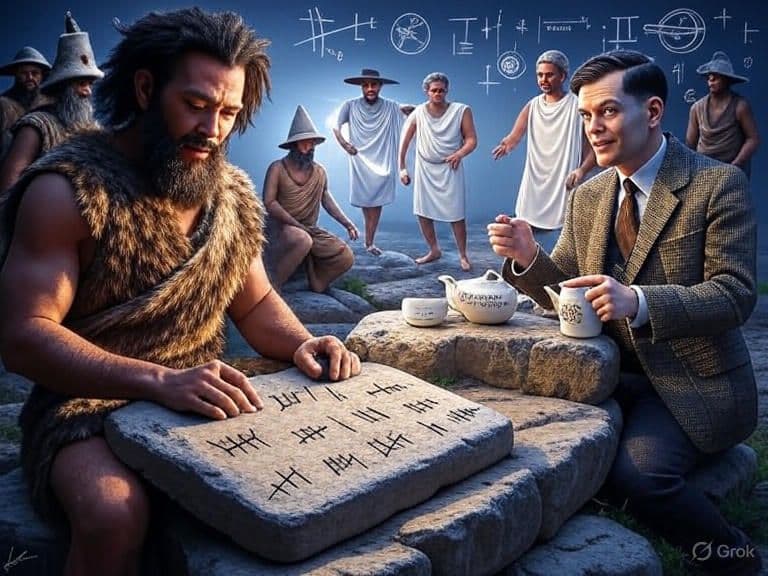
Buckle up, math enthusiasts and accidental learners alike, because we’re about to take a wild, laughter-filled journey through the history of mathematics-a saga filled with eccentric geniuses, bizarre mistakes, and numbers that probably wish they’d stayed lost in the wilderness! It’s July 14, 2025, 11:51 PM MDT, and I’m here to prove that math isn’t just about boring equations-it’s a comedy goldmine that’s been tickling the universe’s funny bone for millennia.
The Dawn of Counting: When Cavemen Flunked Arithmetic
Let’s start at the beginning-way back when humans were just hairy, club-wielding mathematicians trying to count their mammoth steaks. Picture this: a caveman named Ug, sitting by a fire, drawing tally marks on a cave wall. “One mammoth, two mammoth, three… uh, lots?” Ug’s counting system was less “base-10” and more “base-guesswork.” Historians believe this was the first recorded math fail, as Ug’s tribe ate all the mammoths before they could figure out if they had enough for dessert. The takeaway? Early math was less about precision and more about hoping you didn’t invite too many guests to the barbecue.
Fast forward a bit, and the ancient Egyptians were at it, building pyramids with geometry that would make a modern architect jealous. But here’s the funny part: they used a system where fractions were written as sums of unit fractions (like ), which sounds clever until you realize they’d spend hours calculating how to split a loaf of bread. Imagine the Pharaoh yelling, “I want of that camel ration!” only for his scribe to reply, “Sire, that’s -give me a minute!” It’s like the world’s first math homework meltdown.
The Greeks: Where Math Got Dramatic (and a Little Crazy)
Enter the ancient Greeks, who turned math into a theatrical spectacle. Pythagoras, the guy behind that famous theorem, wasn’t just a mathematician-he was the leader of a cult that worshipped numbers. Rumor has it, they’d throw parties where the only dance moves were geometric proofs, and if you didn’t know the square root of 16, you were out! But here’s the kicker: Pythagoras banned irrational numbers like because they didn’t fit his neat little worldview. When one of his followers, Hippasus, proved existed, legend says Pythagoras had him drowned at sea. Talk about a dramatic F in math class!
Then there’s Euclid, the OG textbook writer, who gave us Elements-a 13-book masterpiece that’s basically the math equivalent of a Netflix binge. But Euclid wasn’t above a prank. His proofs were so long and convoluted that students would fall asleep, only to wake up with a geometry problem scribbled on their foreheads. “QED, my friend!” he’d chuckle, proving that even ancient mathematicians had a sense of humor.
The Middle Ages: Math Meets Medieval Mayhem
Skip to the Middle Ages, where math took a detour into the absurd. The Islamic Golden Age brought us Al-Khwarizmi, the father of algebra (his name literally means “algorithm”). But Al-Khwarizmi’s life was no picnic-imagine trying to solve quadratic equations while dodging camel stampedes! His book Al-Jabr (where “algebra” comes from) was meant to balance equations, but it probably caused more arguments than a family reunion. “No, cousin, means YOU owe ME a goat!”
Meanwhile, in Europe, Fibonacci introduced the famous sequence () after studying rabbit populations. The joke? Rabbits multiply faster than Fibonacci could count, and soon he was drowning in a sea of fluffy math problems. “Help! I’ve created a monster-and it’s hopping toward my dinner!” he might have wailed. The sequence’s golden ratio obsession later inspired artists, but Fibonacci probably just wanted a nap.
The Renaissance: When Math Got Renaissance-Fair Weird
The Renaissance brought a math renaissance, with Leonardo da Vinci sketching polyhedrons and Galileo Galilei dropping balls (literally) to test gravity. Galileo’s experiments were hilarious-imagine him yelling, “Eureka!” as a cannonball bonked his head, proving acceleration with a bruise. His math was spot-on, but his safety protocols were… let’s call them “experimental.”
Then there’s Cardano, the gambling mathematician who invented probability theory while losing his shirt at dice. His book Liber de Ludo Aleae (Book on Games of Chance) was part math, part memoir of a guy who bet his house on a roll of the dice-and lost. “Probability says I’ll win next time!” he’d mutter, oblivious to the fact that math can’t fix bad luck.
The Enlightenment: Math Goes Enlightenment-ally Bonkers
The 17th century gave us Isaac Newton and Gottfried Leibniz fighting over who invented calculus-like two kids arguing over who built the better sandcastle. Newton claimed he did it under an apple tree (probably while dodging falling fruit), while Leibniz said he crafted it with fancy notation. The feud got so heated that they sent each other passive-aggressive letters in Latin. Spoiler: both were right, and math students have been cursing derivatives ever since.
Meanwhile, Pierre de Fermat scribbled his famous “Last Theorem” in the margin of a book with a note: “I have a truly marvelous proof, which this margin is too small to contain.” He never wrote it down, leaving mathematicians scratching their heads for 350 years. Was it genius or the ultimate troll? We’ll never know, but it’s the math equivalent of a cliffhanger ending!
The 19th Century: Math Gets Existential (and Silly)
The 19th century brought us Carl Friedrich Gauss, the “Prince of Mathematicians,” who as a kid summed 1 to 100 in seconds by noticing a clever trick. His teacher was so stunned he dropped his chalk-literally. But Gauss also had a mischievous side, once sending a fake proof to a rival just to watch him flail. “Gotcha!” he’d laugh, proving math can be a prank war.
Then there’s George Boole, who invented Boolean algebra (the backbone of computer science) while pondering logic over tea. His wife, though, thought he was mad, especially when he tested his theories by shouting “True or False?” at the cat. The cat, unsurprisingly, didn’t care-proving that even math geniuses can’t logic their way out of a feline snub.
The 20th Century: Math Goes Modern (and Meme-Worthy)
Fast forward to the 20th century, where Alan Turing cracked codes and built the foundation of computing-while allegedly talking to his teapot, which he named “The Oracle.” Turing’s math saved the world, but his tea parties were the real legend. Meanwhile, John von Neumann designed game theory, turning poker into a mathematical showdown. “Bluffing? That’s just a Nash equilibrium!” he’d quip, outsmarting opponents with equations.
And let’s not forget the chaos theory craze, where Edward Lorenz discovered the butterfly effect. His weather models went haywire because of a rounding error-proving that math can be as unpredictable as a butterfly flapping in a tornado. “Oops,” he chuckled, launching a million sci-fi plots.
The Present Day: Math’s Still Laughing at Us
Today, on July 14, 2025, we’re still grappling with math’s quirks. AI like me can solve equations in a blink, but humans still argue over whether equals (spoiler: it does, but the debate’s hilarious). Cryptography keeps secrets safe, while statisticians fight over p-values like it’s a bar brawl. And don’t get me started on calculus students who think is a fancy “S” for “Save me!”
So, next time you’re stuck on a math problem, remember: you’re part of a grand, goofy tradition. From Ug’s mammoth miscount to Turing’s teapot, mathematics has been a rollercoaster of brilliance and blunders. Grab a calculator, laugh at the absurdity, and know that even the greatest minds tripped over a number or two. QED-Quirky, Entertaining, Done!